|
|
WAGNER ACT: An alternative title of the National Labor Relations Act passed in 1935, this modified and replaced the National Industrial Recovery Act that was declared unconstitutional earlier in the year. The Wagner Act was a major labor union promoting act under New Deal program of the Roosevelt administration The Wagner Act, also going by the acronym NLRA, outlawed unfair labor practices by employers, such as the refusal by a firm to negotiate with a union representing a majority of its employees. It also established the National Labor Relations Board, which oversees labor activities.
Visit the GLOSS*arama
|
|


|

|
|
Lesson 18: Monopoly | Unit 3: Output
|
Page: 18 of 30
|
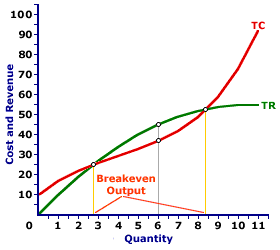
- Examining the profit-maximizing production level using the total revenue and total cost curves:
- Total Revenue: The first curve to note is the total revenue curve, labeled TR.
- Total Cost: The second curve in the graph is the total cost curve, labeled TC.
- Profit is the difference between total revenue and total cost, which is visually seen as the vertical distance between the two curves.
- Notice that the total revenue and total cost curves intersect at two quantities -- between 2 and 3 units and between 8 and 9 units.
- Both quantities are termed breakeven output.
- Breakeven output is the quantity of output in which the total revenue is equal to total cost such that a firm earns exactly a normal profit, but receives no economic profit nor incurs an economic loss.
|
|
|
|
|

|
|
SAY'S LAW A principle of classical economics developed the French economist Jean-Baptiste Say that is commonly summarized as "supply creates its own demand." This law, also referred to as Say's "theory of markets" or "law of markets," indicates that the act of producing aggregate output generates a sufficient amount of aggregate income to purchase all of the output produced. This principle indicated that excess production or insufficient demand for production was unlikely to occur, at least for any extended period. When combined with flexible prices and saving-investment equality, Say's law further implied that an economy would achieve and maintain full employment of resources. This law was singled out by John Maynard Keynes in his critique of classical economics, but remains relevant in current macroeconomic analysis, reflected in the circular flow model.
Complete Entry | Visit the WEB*pedia |

|

|
RED AGGRESSERINE
[What's This?]
Today, you are likely to spend a great deal of time searching for a specialty store looking to buy either a birthday gift for your grandmother or a T-shirt commemorating yesterday. Be on the lookout for the last item on a shelf.
Your Complete Scope
This isn't me! What am I?
|

|
|
The word "fiscal" is derived from a Latin word meaning "moneybag."
|

|
|
"Do something wonderful; people may imitate it. " -- Albert Schweitzer, theologian, physician
|

|
E
Employment
|

|
|
Tell us what you think about AmosWEB. Like what you see? Have suggestions for improvements? Let us know. Click the User Feedback link.
User Feedback
|

|