|
|
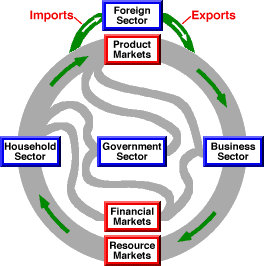
C: The standard abbreviation for consumption expenditures by the household sector, especially when used in the study of macroeconomics. This abbreviation is most often seen in the consumption function, specified as C = a + bY, where Y stands for national income. It is also used for the aggregate expenditure equation, AE = C + I + G + (X - M), where I, G, and (X - M) represent expenditures by the other three macroeconomic sectors, business, government, and foreign.
Visit the GLOSS*arama
|
|


|

|
|
Lesson 13: The Firm | Unit 5: The Bigger Picture
|
Page: 23 of 24
|
- The business sector:
- The business sector is the basic macroeconomic sector containing the private, profit-seeking firms in the economy that combine scarce resources into the production of goods and services.
- The business sector includes all of the productive business firms in the economy.
- This collective of business firms is one of four aggregate sectors used in the macroeconomic analysis of the economy.
- The key function of the business sector is to produce the goods and services.
|
|
|
|
|

|
|
GOLDSMITH BANKING An analysis of banking functions based on the semi-realistic activities of the goldsmith profession of Medieval Europe. Because the gold used a production inputs by goldsmiths was also used as money, they developed many modern banking functions, including maintaining deposits, making loans, keeping reserves, and creating money. While the story of goldsmith banking is often embellished for instructional purposes, it does contain the essence of how goldsmiths operated as banks.
Complete Entry | Visit the WEB*pedia |

|

|
GREEN LOGIGUIN
[What's This?]
Today, you are likely to spend a great deal of time at a dollar discount store hoping to buy either a replacement battery for your pocket calculator or a how-to book on home remodeling. Be on the lookout for strangers with large satchels of used undergarments.
Your Complete Scope
This isn't me! What am I?
|

|
|
Natural gas has no odor. The smell is added artificially so that leaks can be detected.
|

|
|
"The greatest things ever done on Earth have been done little by little. " -- William Jennings Bryan
|

|
SDR
Special Drawing Right
|

|
|
Tell us what you think about AmosWEB. Like what you see? Have suggestions for improvements? Let us know. Click the User Feedback link.
User Feedback
|

|