COMPARATIVE ADVANTAGE: The ability to produce one good at a relatively lower opportunity cost than other goods, especially compared to production in another country. Every person or country has a comparative advantage in production of at least one good or service, even with relatively limited production technology. A related, but contrasting concept is absolute advantage. Both terms are perhaps most important to the study of international trade, but also provide insight into other exchanges.A comparative advantage arises when the production of one good or service can be had at a relatively low opportunity cost, that is, foregoing a relatively small quantity of other production. Technical efficiency or advanced technology that might give rise to an absolute advantage is not the source of comparative advantage. In fact, an extremely productive person or country, one able to produce a great deal of output using few inputs will also be foregoing a great deal of production and incurring a high opportunity cost when produce something else. While a person, country, business, government, or other producing entity may or may not have an absolute advantage in production, every producer has a comparative advantage in the production of something. The Best and the BrightestTo illustrate comparative advantage, consider the production abilities of at Lawrence Alexander III, the best and the brightest. Lawrence has an absolute advantage over everyone in everything he does. He is smarter, a better athlete, more skilled, and more talented than anyone.However, in spite of Lawrence's documented superiority in ALL activities, he does NOT undertake ALL activities. He can craft furniture better than anyone else, but he actually purchases his furniture from others. He is unmatched as an actor and singer, yet he is entertained by watching others perform. He was intelligent enough to pursue any field of academic study in college, including economics, but he chose only to study medicine. If Lawrence can produce everything better than anyone, why then does he purchase anything? Why is he not totally self sufficient in his production and consumption? Enter Opportunity CostThe key to comparative advantage is opportunity cost, the highest valued alternative foregone in the pursuit of an activity. A person (or nation) has a comparative advantage in the production of a good if the relative opportunity cost of production is less.The absolute superiority that Lawrence has in every activity actually works against him when it comes to comparative advantage. Because Lawrence is so incredibly productive, when he undertakes one activity, he foregoes a great deal of alternative production from another activity. The value of this foregone production is the opportunity cost that he incurs. As a skilled surgeon, Dr. Lawrence Alexander III produces valuable life-saving medical care. Which means that foregoing surgery in pursuit another activity leads to an extremely high opportunity cost. Suppose, for example, that Lawrence can generate $1,000 of valuable production for each hour that he spends performing operations. Now suppose that he decides to spend 8 hours building a bookcase, and in so doing, he foregoes 8 hours of surgery. While this might be an extremely well-crafted bookcase, the opportunity cost of its production is $8,000, the value of the foregone surgery. That's an incredibly expensive piece of furniture. Lawrence is actually better off spending his time removing gall bladders and repairing knife wounds, then using the income he generates to buy a bookcase from someone else, someone else with a lower opportunity cost of production. Someone like Becky Carpenter. Becky is an extremely talented carpenter, who can also craft fine furniture. However, unlike Lawrence Alexander III, she is not particularly skilled or talented at other productive activities, including surgery. When she builds a bookcase, she incurs a relatively low opportunity cost because she is giving up very little. She also spends 8 hours making a bookcase, but in so doing all that she gives up is a job working as a clerk at a department store that pays $10 per hour. Her opportunity cost of bookcase construction is only $80. The relative opportunity costs facing Lawrence and Becky are what make specialization and trade possible. Lawrence can specialize in surgery and purchase furniture from Becky. Becky can specialize in furniture production, and if necessary, have Lawrence remove her ruptured appendix. The great thing about this arrangement is that each can become skilled and proficient in their particular productive effort. The same can be said about nations. Specialization and Trade
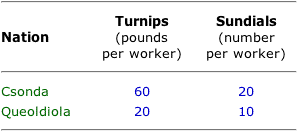
A month of Csondan labor can produce 60 pounds of turnips or 20 sundials, while a Queoldiolan worker can produce only 20 pounds of turnips or 10 sundials with the same amount of effort. Csonda is absolutely the best. But, much like Lawrence, the Csondan absolute advantage actually works against it. Because Csonda can produce more, it incurs a higher opportunity cost of production when producing another good. Consider, the opportunity cost of producing sundials.
The Law of Comparative AdvantageThe inclination for any nation to find a good that it can produce at a lower opportunity cost than another nation is summarized in the law of comparative advantage.The law of comparative advantage states that every nation has a production activity that incurs a lower opportunity cost than that of another nation, which means that trade between the two nations can be beneficial to both if each specializes in the production of a good with lower relative opportunity cost. Because Northwest Queoldiola incurs a lower opportunity cost than Csonda, it makes sense for Csonda to import sundials from Northwest Queoldiola. Check Out These Related Terms... | international economics | international finance | foreign trade | international trade | absolute advantage | law of comparative advantage | gains from trade | Or For A Little Background... | exports | imports | net exports | foreign sector | specialization | opportunity cost | production | technical efficiency | voluntary exchange | And For Further Study... | balance of trade | balance of trade surplus | balance of trade deficit | balance of payments | international market | foreign trade policies | tariffs | import quotas | export subsidies | terms of trade | foreign exchange market | Recommended Citation: COMPARATIVE ADVANTAGE, AmosWEB Encyclonomic WEB*pedia, http://www.AmosWEB.com, AmosWEB LLC, 2000-2025. [Accessed: December 17, 2025]. |