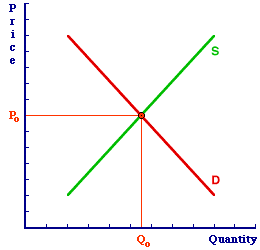
COMPARATIVE STATICS: The technique of comparing the equilibrium resulting from a change in a determinant, or shock to a model, with the equilibrium that existed prior to the change. Comparative statics is the primary analytical technique used in the study of economics.Comparative statics is a technique that compares one static condition with another. A popular example of this technique is found in the study of markets. Comparative statics is used to analyze how the equilibrium price and equilibrium quantity are affected by changes in the demand and supply determinants. Most other economic models, especially graphical models, make use of the comparative static technique. The Market ModelTo illustrate the use of comparative statics, consider the market model. The particular market illustrated here is for hot fudge sundaes. The original or initial equilibrium is indicate by the price Po and the quantity Qo. Comparative statics analyzes how this price and quantity change due to a disruption of the market.A change in any of the demand determinants or supply determinants can trigger such a disruption. In this case, suppose that a change in buyers' preferences causes an increase in demand, or a rightward shift of the demand curve. Specifically, suppose that buyers acquire a sudden craving for hot fudge sundaes due to a change in preferences. A newly released government study proves conclusively that daily consumption of hot fudge sundaes causes an increase in IQ by 30 points and makes people more attractive to the opposite sex. This is just the sort of thing that is bound to change buyers' preferences and increase the demand for hot fudge sundaes. And when demand increases, the previous market equilibrium is disrupted.
No Dynamic PathWhile comparative statics is a powerful analytical tool, which is invaluable to the study of economics, care must be taken with its use. In particular, comparative static analysis only compares one static condition with another. In the analysis of the market, for example, the new equilibrium price-quantity combination is compared with the original price-quantity combination. This comparison between old equilibrium and new says nothing about the dynamic of the adjustment process.
Check Out These Related Terms... | theory | scientific method | assumption | hypothesis | principle | economic analysis | marginal analysis | graphical analysis | Or For A Little Background... | ceteris paribus | model | cause and effect | abstraction | economic thinking | And For Further Study... | fallacies | verification | seven economic rules | positive economics | dismal science | demand determinants | supply determinants | demand shock | supply shock | change in demand | change in supply | market adjustment | aggregate market shocks | multiplier principle | Recommended Citation: COMPARATIVE STATICS, AmosWEB Encyclonomic WEB*pedia, http://www.AmosWEB.com, AmosWEB LLC, 2000-2025. [Accessed: December 16, 2025]. |