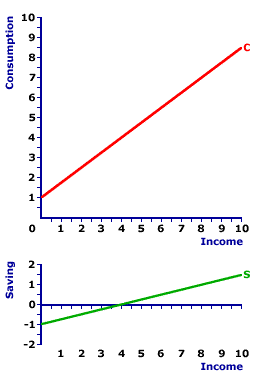
CONSUMPTION EXPENDITURES DETERMINANTS: Ceteris paribus factors, other than income, that are held constant when the consumption line is constructed and which cause the consumption line to shift when they change. Some of the more important consumption expenditures determinants are interest rates, consumer confidence, wealth, and taxes. Due to the relation between consumption and saving, these determinants also cause corresponding, and opposite, shifts of the saving line.Consumption expenditures determinants are ceteris paribus factors that determine the position of the consumption line that plots the induced relation between consumption and income. Changes in these determinants then cause shifts of the consumption line. The fundamental psychological law proposed by John Maynard Keynes as an essential theoretical difference between his theory of Keynesian economics and classical economics indicates that consumption expenditures are primarily based on income. If people have more income, then they are inclined to spend more. Less income inevitably leads to less spending. However, a number of other factors also affect consumption independent of income. For example, a typical consumer like Duncan Thurly might decide to increase consumption expenditures by purchasing an excruciatingly painful root canal from his dentist, Dr. Nova Cain. This extra spending is NOT the result of a sudden windfall of income. Duncan did not receive a year-end bonus from his boss nor did he find a leather satchel of $100 bills on the sidewalk. Rather, this expenditure is undertaken for "other reasons" unrelated to his income. That specific reason is to eliminate the excruciatingly painful cavity in his tooth. Moreover, if this extra spending is not undertaken with extra income, then it necessarily results in a decline in saving. What They Do
The exhibit to the right presents the consumption line in the top panel and the saving line in the bottom panel. The saving line is also included because consumption expenditures determinants also affect the saving line. A change in consumption expenditures are invariably matched by an opposite change in saving. Consumption expenditures determinants can trigger either an increase or a decrease in consumption and a corresponding decrease and increase in saving. (The only notable exception is taxes.)
What They AreWhile individuals such as Duncan are bound to encounter a wide range of specific non-income factors affecting individual spending (including unexpected root canals), determinants affecting overall consumption expenditures by the aggregate household sector are more limited. Some of the more important determinants are:
Check Out These Related Terms... | consumption schedule | consumption line | consumption function | induced consumption | autonomous consumption | average propensity to consume | marginal propensity to consume | saving schedule | saving line | saving function | induced saving | autonomous saving | average propensity to save | marginal propensity to save | derivation, consumption line | slope, consumption line | intercept, consumption line | derivation, saving line | slope, saving line | intercept, saving line | effective demand | psychological law | Or For A Little Background... | consumption | consumption expenditures | saving | determinants | Keynesian economics | macroeconomics | household sector | disposable income | national income | gross domestic product | taxes | And For Further Study... | personal consumption expenditures | induced expenditures | autonomous expenditures | aggregate expenditures | aggregate expenditures line | derivation, saving line | consumption expenditures determinants | Keynesian model | Keynesian equilibrium | injections-leakages model | aggregate demand | paradox of thrift | fiscal policy | multiplier | Recommended Citation: CONSUMPTION EXPENDITURES DETERMINANTS, AmosWEB Encyclonomic WEB*pedia, http://www.AmosWEB.com, AmosWEB LLC, 2000-2025. [Accessed: December 16, 2025]. |