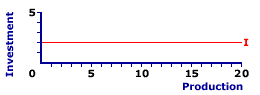
INVESTMENT LINE: A graphical depiction of the relation between investment expenditures by the business sector and the economy's aggregate level of income or production. This relation plays a key role in the study of Keynesian economics. A investment line is characterized by vertical intercept, which indicates autonomous investment, and slope, which is the marginal propensity to invest and indicates induced investment. The aggregate expenditures line used in Keynesian economics is derived by adding or stacking the investment line onto the consumption line, then adding government purchases and net exports to this stack.The investment line, also termed propensity-to-invest line, shows the relation between investment expenditures by the business sector and aggregate income or production. The income and production measures most commonly used are national income and gross domestic product. The purpose of the investment line is to graphically illustrate the investment-income relation for the business sector, which is then integrated into the aggregate expenditures line used in Keynesian economics. The investment line is commonly presented in one of two forms reflecting autonomous investment and induced investment. The simplest is a horizontal investment line, one with a zero slope, that illustrates autonomous investment. With a horizontal line, investment expenditures are constant for all levels of aggregate income or production, hence autonomous and unaffected by income. A more realistic investment line is positively sloped, indicating a degree of induced investment. In this case, the vertical intercept, or Y-intercept, of the investment line marks autonomous investment and the slope represents induced investment. Of no small importance, the slope of the investment line is also the marginal propensity to invest (MPI).
An alternative investment line, one with induced investment, can be illustrated in the exhibit with a simple click of the [An Induced Line] button. The new red line, labeled I' in the exhibit, is positively sloped, indicating that a change in the level of income or production induces a change in investment expenditures. This new investment line actually indicates both induced investment and autonomous investment. The slope is induced investment and the intercept is autonomous investment.
Check Out These Related Terms... | induced investment | autonomous investment | marginal propensity to invest | slope, investment line | intercept, investment line | consumption line | saving line | government purchases line | net exports line | Or For A Little Background... | investment | investment expenditures | Keynesian economics | macroeconomics | business sector | national income | gross domestic product | And For Further Study... | induced expenditures | autonomous expenditures | aggregate expenditures | aggregate expenditures line | derivation, consumption line | investment expenditures determinants | Keynesian model | Keynesian equilibrium | injections-leakages model | aggregate demand | paradox of thrift | fiscal policy | multiplier | investment, production possibilities | investment business cycles | Recommended Citation: INVESTMENT LINE, AmosWEB Encyclonomic WEB*pedia, http://www.AmosWEB.com, AmosWEB LLC, 2000-2025. [Accessed: December 12, 2025]. |