LAW OF INCREASING OPPORTUNITY COST: The proposition that opportunity cost, the value of foregone production, increases as the quantity of a good produced increases. This fundamental economic principles can be seen in the production possibilities schedule and is illustrated graphically through the slope of the production possibilities curve. It generates a distinctive convex shape, flat at the top and steep at the bottom.Production possibilities, which analyzes the alternative combinations of two goods that an economy can produce with given resources and technology, reflects the opportunity cost of production. In particular, the slope of a production possibilities curve is the opportunity cost of the good measured on the horizontal axis. This opportunity cost increases as production increases. The Production Possibilities Schedule
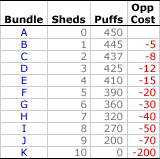
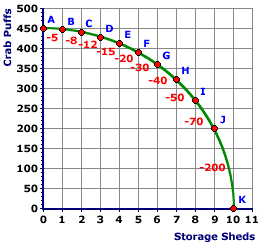
The source of increasing opportunity cost rests with resource variability. The third rule of inequality indicates that resources are not all the same. Some resources are better suited for producing crab puffs and others are better suited for fabricating storage sheds. When ALL resources are used for crab puffs, some of these resources are very productive at producing crab puffs and others are much less so. What happens when resources are reallocated, when the first storage shed is produced? With the assumption of technical efficiency, the first resources removed from crab puff production and directed toward the fabrication of storage sheds are those BEST suited to fabricating storage sheds and LEAST suited to producing crab puffs. As such, very few crab puffs are sacrificed to make the first storage shed. The opportunity cost of this one storage shed is 5 crab puffs, indicated by the change from bundle A to bundle B. However, the last few resources removed kicking and screaming from crab puff production are those BEST suited for crab puffs and LEAST suited for storage sheds. The economy is losing a lot of crab puffs to make one storage shed. At bundle K, the cost of the eleventh storage shed is a whopping 200 dozen crab puffs. What does this mean for the economy? The law of increasing opportunity cost is fundamental to the production and supply of goods. In general, as the economy increases the quantity supplied of a good, the opportunity cost increases. And if cost is higher, then sellers need a higher price, resulting in the law of supply. The Production Possibilities Curve
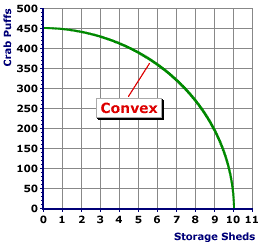
Moving along the production possibilities curve, the slope becomes steeper (that is, the absolute value of the slope increases), reaching a value of -200 (an absolute value of 200) between points J and K. This reflects the law of increasing opportunity cost and results in the convex shape for the production possibilities curve.
Check Out These Related Terms... | derivation, production possibilities curve | investment, production possibilities | full employment, production possibilities | unemployment, production possibilities | economic growth, production possibilities | economic growth, sources | Or For A Little Background... | opportunity cost | production possibilities | production possibilities curve | opportunity cost, production possibilities | assumptions, production possibilities | slope, production possibilities curve | technical efficiency | graphical analysis | principle | scientific method | technology | third rule of inequality | And For Further Study... | economic efficiency | efficiency | economic cost | seven economic rules | free lunch | three questions of allocation | marginal cost | law of diminishing marginal returns | market supply | production cost | law of supply | short-run production analysis | long-run production analysis | diseconomies of scale | marginal cost | Recommended Citation: LAW OF INCREASING OPPORTUNITY COST, AmosWEB Encyclonomic WEB*pedia, http://www.AmosWEB.com, AmosWEB LLC, 2000-2025. [Accessed: December 16, 2025]. |