MARKET: The organized exchange of commodities (goods, services, or resources) between buyers and sellers within a specific geographic area and during a given period of time. Markets are the exchange between buyers who want a good (the demand-side of the market) and the sellers who have it (the supply-side of the market).A market is the mechanism used to exchange commodities and to address the scarcity problem. It is the primary method used to allocate resources in modern economies. As such, it is also a cornerstone of the study of economics. Addressing ScarcityMarkets were devised by human beings in the never-ending quest to address the fundamental scarcity problem (unlimited wants and needs, but limited resources).
What is TradedMarkets are used to exchange a wide range of commodities, including goods, services, and resources.
While, in principle, almost any commodity of value can be exchanged through markets, a few important exceptions exist. These exceptions can be seen through two primary characteristics.
Efficiency problems inevitably result if markets are not used to exchange private goods, or if they are used to exchange public, near-public, and common-property goods. The Price of ExchangeMost market exchanges in modern economies involve a commodity on one side and a monetary payment on the other. In essence, a buyer gives up money and receives a good, while a seller gives up a good and receives money. For example, when Duncan Thurly buys a Hot Momma Fudge Bananarama Ice Cream Sundae for $2, he acquires the sundae and gives up $2. The Hot Momma Fudge Bananarama Ice Cream Shoppe receives $2 and gives up the sundae.The monetary payment side of the exchange is generally termed the price. For example, the price of the Hot Momma Fudge Bananarama Ice Cream Sundae in the previous example is $2. While most markets involve the exchange of money for a commodity, a monetary payment is not essential to the process. That is, one commodity can be traded for another, doing what is commonly termed barter. Duncan Thurly, for example, could conceivably "buy" a Hot Momma Fudge Bananarama Ice Cream Sundae by giving up something like an autographed photograph of Brace Brickhead, Medical Detective. No money is needed. A Voluntary ProcessMarket exchanges are a voluntary means of allocating resources. Buyers and sellers enter into the exchange without coercion, that is, without government laws, rules, regulations, or mandates. Buyers and sellers buy or sell if they choose to. The decision is theirs. Buyers buy want they want (if the price is satisfactory). Sellers sell what they want (if the price is satisfactory).The Market Model
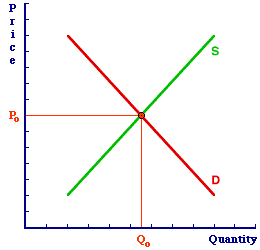
A representative abstract market model is illustrated in this exhibit. Like any abstraction, this model seeks to capture the relevant information (demand, supply, price, quantity) while ignoring (hopefully) unimportant details. In this diagram, the demand side of the market is represented by the negatively-sloped demand curve, labeled D. The supply side of the market is represented by the positively-sloped supply curve, labeled S. The intersection of the two curves represents the equilibrium price and quantity, the price at which buyers and sellers are willing and able to exchange the same quantity. An key use of the market model is comparative statics, an analysis of how equilibrium price and quantity are affected if the market is disrupted by a change in one or more demand or supply determinant. Comparative statics can answer such questions as "How would the price of Hot Momma Fudge Bananarama Ice Cream Sundae change if buyers had more income?" An Efficient ProcessMarkets are much beloved among pointy-headed economists (especially those who live and work in capitalistic economies), because they can efficiently allocate resources with little or no government intervention. To do so, however, markets must be competitive and otherwise free of market failures.Markets are efficient if satisfaction cannot be increased by exchanging more or less of the commodity. This results because the satisfaction (or value) obtained from the last unit of the commodity produced and exchanged is equal to the satisfaction (or value) foregone by not producing other commodities, that is opportunity cost. In a competitive market free of market failures, this is achieved in equilibrium with equality between the demand price and the supply price. Market FailuresMarkets are not efficient if they are afflicted by market failures. The four most important market failures are: (1) public goods, (2) market control, (3) externalities, and (4) imperfection information. Each of these prevent the equality between the value of the commodity exchanged and the value of other commodities foregone.Public goods, as noted earlier, are commodities characterized by problems with excluding non-payers and by non-rival consumption. Market control emerges if one side of the market faces little or no competition. Externalities occur if the demand price does not reflect the overall value of the commodity exchanged or if the supply price does not reflect the overall opportunity cost of production. Imperfect information means that either buyers or sellers lack adequate information about the commodity being exchanged. Alternative Market StructuresThe degree of competition among buyers or sellers determines the basic structure of a market. The four most common types of market structures are based on differing numbers of competitors on the supply-side of the market.
A Market-Oriented EconomyMarkets are one of two methods used by society to allocate resources. The other is government. While real world economic systems use both, they rely on each to different degrees. A market-oriented economy (also termed capitalism) makes extensive use of markets, with a modest amount of government intervention. Government intervention is generally aimed at, or justified by, the correction of market failures.Check Out These Related Terms... | market demand | market supply | competition | exchange | price | quantity | competitive market | Or For A Little Background... | scarcity | three questions of allocation | opportunity cost | first rule of scarcity | fourth rule of competition | graphical analysis | economic thinking | production possibilities | model | efficiency | invisible hand | good | service | abstraction | And For Further Study... | competitive market | voluntary exchange | Marshallian cross | market equilibrium | market adjustment | comparative statics | market-oriented economy | capitalism | economic system | macroeconomic markets | elasticity | price elasticity of demand | price elasticity of supply | barter | medium of exchange | Recommended Citation: MARKET, AmosWEB Encyclonomic WEB*pedia, http://www.AmosWEB.com, AmosWEB LLC, 2000-2025. [Accessed: December 16, 2025]. |