MARKET FAILURES: Imperfections in the exchange process between buyers and sellers that prevent markets from efficiently allocating scarce resources. Market failures come in four varieties -- public goods, market control, externalities, and imperfect information. Market efficiency is achieved if the value of goods produced is equal to the value of foregone production. Markets fail when this efficiency condition is not achieved. Such failures can only be corrected by government intervention.Market failures arise when the voluntary exchange process does achieve the allocative efficiency criterion that the value of goods produced equals the value of goods not produced. The four types of market failures are public goods, market control, externalities, and imperfect information. Public goods causes inefficiency because nonpayers cannot be excluded from consumption, which then prevents voluntary market exchanges. Market control occurs because limited competition among buyers or sellers prevents the equality between demand price and supply price. Externalities prevent efficiency because external costs or benefits mean demand prices or supply prices do not fully reflect the value of goods produced or the value of goods not produced. Imperfect information among buyers or sellers, like externalities, also means that demand prices or supply prices do not fully reflect the value of goods produced or the value of goods not produced. While markets do a relatively good (that is, efficient) job of allocating resources under most circumstances, when they fail, the ONLY alternative is some sort of government intervention. Intervention might take the form of direct government provision or production, often done with public goods. Or intervention might be laws or regulation, a common remedy for market control and imperfect information. Government taxes are another method of intervention that is often recommended for externalities. Market Efficiency
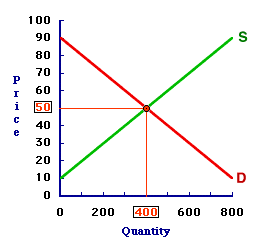
The exhibit to the right illustrates a typical market. Equilibrium is achieved at a market price of $50 and quantity of 400. In a perfect world, with a perfect market, the demand price fully reflects the value of the good produced and the supply price fully reflects the value of goods not produced. Because demand price is equal to supply price at the equilibrium price of $50, efficiency is also achieved at equilibrium. Unfortunately for markets to achieve efficiency, a few conditions must be achieved:
Public GoodsPublic goods are goods that can be consumed simultaneously by a large number of people without the consumption by one imposing an opportunity cost on others, what is termed nonrival consumption. They are further characterized by the inability to exclude nonpayers from consumption. Nonrival consumption means that public goods are efficiently allocated if provided at a zero price, something markets are seldom inclined to do. Moreover, the inability to exclude nonpayers gives rise to the free-rider problem, which further inhibits the voluntary exchange of public goods through markets.If markets do attempt the voluntary exchange of public goods, which results in a nonzero market price, then efficiency is not achieved. A nonzero market price means there is no equality between the value of goods produced and the value, or opportunity cost, of goods not produced, which is zero due to nonrival consumption. Common examples of public goods include national defense, public health and environmental quality. In each case consumption by one does not impose an opportunity cost on others and nonpayers cannot be excluded from consumption. And in each case, markets fail to efficiently allocate the production, consumption, or provision. Closely related to public goods are near-public goods and common-property goods that share one but not both of the key characteristics of nonrival consumption or the inability to exclude nonpayers.
Market ControlMarket control arises when buyers or sellers are able to exert influence over the price of a good and/or the quantity exchanged. The ability to control the market, especially the market price, prevents a market from equating demand price and supply price.Market control on the supply side allows sellers to set a demand price, the value of the good produced, above the value of goods not produced. An extreme example of market control on the supply side exists with monopoly, a market with a single seller. A less extreme, but more common example, is oligopoly, a market with a small number of large sellers. Market control on the demand side allows buyers to set a supply price, the value of goods not produced, below the value of the good produced. An extreme example of market control on the demand side exists with monopsony, a market with a single buyer. A less extreme, but more common example, is oligopsony, a market with a small number of large buyers. Common examples of markets with supply-side or demand-side control include city-wide electrical distribution (monopoly), automobile manufacturing (oligopoly), employment in a company town (monopsony), and employment in professional sports (oligopsony). ExternalitiesAn externality exists if a benefit is not included in the demand price or a cost is not included in the supply price. This means that the demand price does not reflect the complete value of the good produced or the supply price does not reflect the complete value of goods not produced. As such, market equilibrium does not achieve an efficient allocation.A noted externality example is pollution. The emission of residuals in the production or consumption of goods impose opportunity costs on others not involved the market exchange. In this case the supply price in the market does not include all opportunity costs of production, the omitted costs are those imposed on others harmed by the pollution. On the benefit side, education provides an example of an externality. The benefits of education extend beyond those receiving the education and thus beyond the market exchange. In this case the demand price in the market does not include the full value of the good production, the omitted value is that received by others benefitting from the education. Imperfection InformationThe lack of information among buyers or sellers often means that the demand price does not reflect all benefits of a good or the supply price does not reflect all opportunity costs of production. That is, buyers might be willing to pay more or less for a good because they don't know the true benefits generated. Or sellers might be willing to accept more or less for a good than the true opportunity cost of production.In many cases, sellers have better information about a good that buyers. Sellers own and control the good, they have direct contact with the good. If there are defects or problems with the good, they are likely to know. Buyers, in contrast, have much less familarity with a good, perhaps only knowing the information provided by the sellers. In this case, buyers are likely to have a different demand price than the value of the good produced, a value based on more complete information. Fixing FailuresShould markets fail for one or more of these reasons, governments are often called into action. The very existence of governments is largely attributable to the market failure of public goods. The scope of modern governments has expanded over the years to address other market failures.Governments have three key tools for addressing the market failures of public goods, market control, externalities, and imperfect information.
Government InefficienciesWhile market failures can be corrected, in principle, only through some sort of government action, government intervention does not guarantee a solution nor an efficient allocation of resources. The reason is that governments are also imperfect. Governments have their own set of inefficiencies.A list of government inefficiencies includes:
Check Out These Related Terms... | public finance | good types | public goods | private goods | near-public goods | common-property goods | free-rider problem | taxation principles | Or For A Little Background... | markets | market control | efficiency | market efficiency | market equilibrium | monopoly | monopsony | oligopoly | oligopsony | fourth rule of competition | fifth rule of imperfection | taxes | demand price | supply price | And For Further Study... | public choice | public goods: demand | public goods: efficiency | consumption rivalry | nonpayer excludability | tax proportionality | tax equity | Recommended Citation: MARKET FAILURES, AmosWEB Encyclonomic WEB*pedia, http://www.AmosWEB.com, AmosWEB LLC, 2000-2025. [Accessed: December 16, 2025]. |