MEDIAN VOTER PRINCIPLE: A public choice principle stating that the median voter, the voter with an equal number of votes on either side, determines the outcome of an election by determining which side receives the majority. The preferences of this median vote, thus become the most important preferences addressed by candidates running for election. However, the median voter's preferences might not generate was is best, that is, efficient, for society. Other related voting problems identified by the study of public choice includes the voting paradox, logrolling, and voter apathy (due to rational ignorance and rational abstention).The median voter principle highlights the important role that the middle of the voting spectrum plays in an election guided by majority rules voting. The outcome of a majority rules election is determined by the candidate or issue that obtains ONE vote more than 50 percent. This single vote can then determine the outcome. For example, suppose that 100,000,001 people cast votes for two Presidential candidates -- Don the Democrat and Ron the Republican. As the election draws to its conclusion 50,000,000 votes are cast for Don the Democrat and 50,000,000 votes are cast for Ron the Republican. On single person, Issac Irving, is yet to vote. Issac (a registered Independent) could go either way; sees valid points made by each candidate; is on the fence. Issac is the median voter here. And whichever candidate Issac selects wins the election. Of course, both candidates are bound to recognize the importance of Issac's vote and are likely to customize their campaigns to acquire his vote. Moving to the MiddleLance LaLandon, Vice Mayor of Shady Valley and Chairman of the Committee for the Historical Preservation of Footwear (the Shoe Museum), has called a meeting to approve the featured Decade of Footwear display for the Founder's Day exhibit. This exhibit is the center piece of the month-long celebration leading up to Shady Valley Founder's Day, which attracts thousands upon thousands of tourists and brings in oodles upon oodles of revenue to city. The Decade of Footwear display plays no small part in the success or failure of the Founder's Day celebration.The committee must, it absolutely must, approve an appropriate featured Decade of Footwear. Unfortunately the committee's performance up to this point is not encouraging. Each of the seven committee members, Lance included, prefers a different featured decade. Our only option is to put it up to a vote. As the committee prepares to vote on the featured decade, the median voter principle is bound to influence the choice. In many elections, political candidates have the tendency to move to the middle of the political spectrum. Conservative candidates on the right side of the spectrum often moderate their views, moving to the left and becoming a bit more liberal. Liberal candidates on the left also tend to moderate their views, moving to the right and becoming a bit more conservative. Perhaps I should say that successful political candidates, the ones who win elections, are the ones who move to the middle. Unsuccessful candidates tend to stay on the fringes of the political spectrum. The Median VoterThe median voter is the voter in the middle of the political spectrum. But not middle in terms of average or arithmetic mean. The median is the one with an equal number of voters on either side. For example, the seven members of the Shoe Museum Committee prefer seven different featured decades for the Founder's Day exhibit -- 1790s, 1830s, 1850s, 1960s, 1970s, 1980s, and 1990s.Three of the committee members prefer featured decade from the distant past, while four prefer more recent decades. A simple arithmetic average, or mean, of these seven options is the 1910s. But I doubt that this is the decade that would be selected when put to a vote of the seven committee members. Rather the median decade, 1960, the decade with an equal number of votes on either side -- three prefer a older decade and three prefer a more recent decade -- is likely to come out on top of a majority vote. Majority Rules
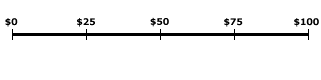
Recognizing Myrna's voting indecision, Reginald is likely to increase his proposed education spending to $26 million. Click the [Spend More] button in the exhibit to illustrate. In so doing, he becomes "more attractive" to Myrna, reducing the difference from his position and hers from $25 million to $24 million. Moreover, this move will not dissuade any of the other voters. Reginald is still the "best" candidate for the 50 voters wanting to spend $0 to $49 million. This would lead to victory for Reginald. However, Drake is unlikely to stand by as Reginald makes the adjustment needed to attack Myrna's vote. Drake is bound to decrease his proposed spending from $75 million to $73 million. Click the [Spend Less] button in the exhibit to illustrate. His new proposal places him closer to Myrna's preference, a difference of only $23 million. Moreover, this move will not dissuade any of the other voters, either. Drake remains the "best" candidate for the 50 voters wanting to spend $51 to $100 million. This would then lead to victory for Drake. But, Reginald is likely to react with another increase, which prompts Drake to propose a decrease, which induces Reginald to go with another increase, which motivates Drake for another decrease... and on it goes. The end result is that both Reginald and Drake end up proposing $50 million in education spending, exactly the amount preferred by Myrna the median voter. Because each candidate keeps their original 50 voters, the election is then decided when Myrna flips a coin before entering the voting booth. What does this mean for my Shoe Museum Committee? Of the seven decade options, 1960 is the one in the middle, the median option. It's the only option that will attack a majority of the committee votes, in this case, the four members preferring a more recent decade. It also happens to be the decade that Vice Mayor Lance favors. (Okay, so he likes those pointy-toed "Beatle shoes" and white high-top Converse All Stars, not to mention "Go-Go boots.") What About Efficiency?But are the dictates of the median voter efficient? This is the key question for this present discussion. In the Shady Valley Board of Education election example, the winning candidate supports Myrna's $50 million spending option. But is $50 million the level of education spending that generates an efficient allocation of resources?The answer is: Not necessarily. In fact, the answer is: Probably not. There is nothing special about Myrna's $50 million spending preference, other than half of the voters want to spend more and half want to spend less. There is no reason to think that Myrna has any special insight into the equality between the value of goods produced and the value of goods not produced -- the criterion for efficiency. Suppose, for example, that spending preferences, rather than being equally distributed between $0 and $100 million, are concentrated at either end. That is, 50 voters want to spend $0 and 50 voters want to spend $100 million. In this case, whatever spending level Myrna the median voter prefers is the amount spent. If Myrna prefers $1 million, then that is the amount that will attack both candidates. If Myrna prefers $99 million, then that ends up being the amount selected by the candidates. Neither amount is necessarily efficient. And for the Shoe Museum Committee, as the median voter, Lance's choice of decades (so long as he stays median) is the one selected. If he wants to go with the 1860s, then the 1860s it is. If he prefers the 1930s, then that is the decade selected. But is his decade necessarily the one that will be best for the Founder's Day celebration? Probably not. Other Voting ProblemsThe voting process might not result in an efficient allocation of resources due to three additional problems -- the voting paradox, logrolling, and rational voter apathy.
Check Out These Related Terms... | voting problems | logrolling | voting paradox | government failures | rational ignorance | rational abstention | voting rules | special interest groups | Or For A Little Background... | public choice | public choice politics | political game | political views | conservative | liberal | market failures | government functions | public finance | efficiency | public sector | private sector | utility maximization | fifth rule of imperfection | seven economic rules | And For Further Study... | political entrepreneurs | capture theory of regulation | rent seeking | Tiebout hypothesis | principal-agent problem | government bureaucracies | Recommended Citation: MEDIAN VOTER PRINCIPLE, AmosWEB Encyclonomic WEB*pedia, http://www.AmosWEB.com, AmosWEB LLC, 2000-2025. [Accessed: December 16, 2025]. |