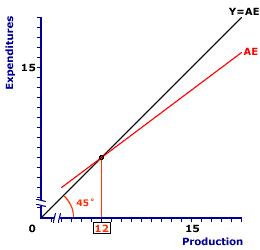
MULTIPLIER, SLOPE OF AGGREGATE EXPENDITURES LINE: The slope of the aggregate expenditures line determines the magnitude of the multiplier process and the numerical value of the multiplier. In particular, the expenditures multiplier is the inverse of one minus the slope of the aggregate expenditures line. This slope is largely based on the marginal propensity to consume, but also depends on other induced activities. A steeper slope generates a larger multiplier and a flatter slope leads to a smaller multiplier.The standard Keynesian expenditures multiplier is the inverse of one minus the slope of the aggregate expenditures line. The slope of the aggregate expenditures line captures the extent to which consumption expenditures, investment expenditures, government purchases, and other macroeconomic activities are induced by aggregate production and income. If the slope is steeper and aggregate expenditures are induced more by aggregate production, then the multiplier is greater. The Multiplier FormulaThe total change in aggregate production caused by an autonomous expenditure change depends on the extent to which consumption and other expenditures are induced by income.Consider if you will the simple formula for the multiplier m stated in terms of the marginal propensity to consume and the marginal propensity to save. For example, if 75 percent of the income received by the household sector is used for consumption (a marginal propensity to consume of 0.75) then the multiplier is 4. A larger marginal propensity to consume means a larger multiplier. A smaller marginal propensity to consume means a smaller multiplier. If the marginal propensity to consume is 0.9, then the multiplier is 10. If the marginal propensity to consume is 0.6, then the multiplier is 2.5. If consumption is the only induced expenditure, then the marginal propensity to consume is the slope of the aggregate expenditures line. However, in more complex models, the slope of the aggregate expenditures line depends on other induced factors, which also affects the value of the multiplier. As such, a more general formula for the multiplier m is stated as the slope of the aggregate expenditures line. With this specification, the connection between the multiplier and the slope of the aggregate expenditures line, and induced activity that affects this slope, is explicitly stated. If the slope is greater, the denominator of the equation is smaller (because the slope is subtracted from 1), and hence the multiplier is larger. Changing Slopes
Check Out These Related Terms... | multiplier | multiplier principle | multiplier, Keynesian cross | multiplier, injections-leakages model | simple expenditures multiplier | simple tax multiplier | expenditures multiplier | tax multiplier | balanced-budget multiplier | Or For A Little Background... | Keynesian economics | two-sector Keynesian model | Keynesian cross | aggregate expenditures | induced expenditures | autonomous expenditures | consumption function | marginal propensity to consume | marginal propensity to save | aggregate expenditures determinants | And For Further Study... | multiplier, aggregate market | paradox of thrift | money multiplier | fiscal policy | Recommended Citation: MULTIPLIER, SLOPE OF AGGREGATE EXPENDITURES LINE, AmosWEB Encyclonomic WEB*pedia, http://www.AmosWEB.com, AmosWEB LLC, 2000-2025. [Accessed: December 16, 2025]. |