TAX EFFICIENCY: Taxes, mandatory payments used to finance government operations, inherently disrupt the allocation of resources. This disruption might be good, correcting an otherwise inefficient allocation caused by pollution or market control. However, for an already efficiency allocation, a tax creates and inefficient wedge between the demand price and the supply price. This tax is generally paid partially by buyers and partially by sellers, which the tax incidence. Inefficiency arises because a tax reduces the total amount of consumer surplus and producer surplus, which is deadweight loss.Taxes inherently disrupt the allocation of resources. While such disruption might be good, correcting an otherwise inefficient allocation, it can also disrupt what would be an efficient allocation. An efficient market generates equality between demand price, the value of the good produced, and supply price, the value of goods not produced. Placing a tax on the good, service, or activity exchanged through an efficient market necessarily disrupts this equality between demand price and supply price. In particular it drives a wedge between the two prices. This tax wedge means that buyers and sellers each generally pay a portion of the tax and is the source of inefficiency. The incidence of a tax, that is, how much of the tax is paid by buyers and how much by sellers, depends on the demand and supply prices before the tax compared to after the tax. Inefficiency arises a tax causes an overall decrease in consumer surplus and producer surplus. A portion of the consumer and producer surplus that exists in an untaxed is transferred to government as the tax, which can then be used to finance government operations. However, a portion of this surplus also simply disappears. Society gains nothing in return for this lost surplus. An Efficient Market
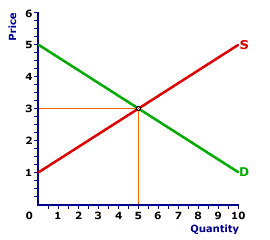
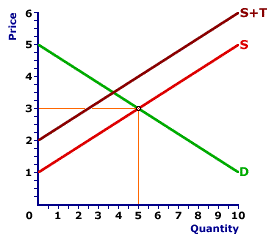
This equilibrium is efficient because the demand price and supply price are equal at $3. The value of the good produced is equal to the value of goods not produced. It is not possible to produce more or less of this good such that society's level of satisfaction increases. The Tax WedgeHowever, placing a tax on an efficient market disrupts the efficiency. Consider how a tax is included in this market. The easiest way to do this, from a graphical perspective, is to treat the tax as a cost of production. While a tax is not really an opportunity cost, from the economy's perspective, if paying the tax is the responsibility of the suppliers, then it can be viewed as a "cost of doing business" for the suppliers.For this reason, we can identify a new "supply" curve that is the original supply curve plus the tax. For ease of exposition, let's say that a per unit tax of $1 is added to supply. The result is a new "supply" curve, which lies above and to the left of the original supply curve. This new supply curve, labeled S + T, can be revealed by a click of the [Add the Tax] button. The inclusion of a tax has much the same affect as an increase in any resource price or the cost of production, technically termed a decrease in supply. Before getting to the new equilibrium achieved with the tax, take a closer look at exactly what the tax does. The tax drives a "wedge" between the price buyers pay (the demand price) and the price sellers receive (the supply price). The demand price is the price corresponding with the demand curve (D) and the supply price is the price corresponding with the original supply curve (S). To illustrate this tax wedge, click the [Tax Wedge] button. Doing so highlights that a $1 per unit tax effectively creates a $1 difference between the demand price and supply price. This position of this wedge effectively determines the after-tax equilibrium for this market. Tax Incidence
The next step is identify the market equilibrium achieved after the tax is imposed on the market. This is found at the intersection of the original demand curve (D) and the new "supply curve" (S + T). A click of the [Equilibrium] button reveals this result. The market achieves equilibrium with a price of $3.50 and a quantity of 3.75. The result of this per unit tax is a higher price and a decrease in the quantity exchanged, just like any decrease in supply. In fact, the inclusion of a tax has much the same affect on a market as an increase in any resource price. The price goes up and the quantity goes down. However, while the market equilibrium price is higher and the buyers are paying a higher price to purchase this good, the sellers are not receiving this higher price. Part of the higher price goes to government as the tax. So, who is really paying the tax? Buyers? Or sellers? Who Pays?As a general rule, both buyers and sellers pay a share of the tax. The question of who pays the tax and how much is termed tax incidence, the division of a tax between buyers and sellers. Tax incidence is found as the difference between the pre-tax market equilibrium price and the demand and supply prices that result after the tax is imposed.
In this example, $0.50 of the $1 per unit tax is paid by buyers and $0.50 is paid by sellers. A tax is seldom equally divided among buyers and sellers, as in this simplistic example. The actual tax incidence is based on the shapes, slopes, and elasticities of the demand and supply curves. Deadweight Loss
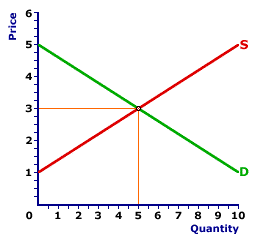
This transfer is NOT the source of the inefficiency. Something else is a work. A Lot of SurplusA market such as the one illustrated here is efficient not just because demand price is equal to supply price (and the value of the good produced is equal to the value of goods not produced) but also because the sum of consumer surplus and producer surplus is maximized.
Enter the TaxImposing a tax on this market does two things.
This difference is termed deadweight loss. The deadweight loss triangle simply vanishes when a tax is imposed on the market. It is a loss incurred by society. Resources are not being used to generate the greatest possible satisfaction. An Inefficient StartBefore leaving this discussion, consider one last, important point. In this example, the tax causes an efficient market to become inefficient. But what if the market starts inefficient? What if a market failure -- such as market control, an external cost or benefit, or imperfect information -- creates an inefficient market before the tax.In this case, it's possible that the tax actually corrects the inefficient market failure and achieves an efficient allocation. In fact, a tax is often recommended as a means to correct the market failure caused by an external cost. Check Out These Related Terms... | tax incidence | tax wedge | deadweight loss | taxation principles | taxation basics | tax effects | revenue effect | allocation effect | tax equity | ability-to-pay principle | benefit principle | horizontal equity | vertical equity | tax proportionality | proportional tax | progressive tax | regressive tax | Or For A Little Background... | public finance | government functions | efficiency | inefficient | market equilibrium | market efficiency | consumer surplus | producer surplus | allocation | And For Further Study... | public choice | good types | market failures | public goods: demand | public goods: efficiency | tax multiplier | personal tax and nontax payments | transfer payments | Recommended Citation: TAX EFFICIENCY, AmosWEB Encyclonomic WEB*pedia, http://www.AmosWEB.com, AmosWEB LLC, 2000-2025. [Accessed: December 16, 2025]. |