|
|
AD-AS MODEL: An economic model relating the price level and real production that is used to analyze business cycles, gross domestic product, unemployment, inflation, stabilization policies, and related macroeconomic phenomena. The AS-AD model, inspired by the standard market model, captures the interaction between aggregate demand (the buyers) and short-run and long-run aggregate supply (the sellers).
Visit the GLOSS*arama
|
|


|

|
|
Lesson 23: Factor Market Equilibrium | Unit 2: Market Control
|
Page: 8 of 24
|
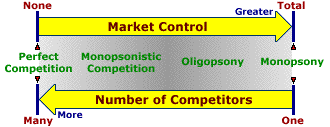
- Here's a list of resource market structures that have buying-side market control:
- Perfect competition: This has exactly the same name as the selling-side market structure because perfect competition is really based on large numbers of both buyers and sellers exchanging an identical production.
- Monopsonistic competition: This is the buying-side equivalent of monopolistic competition.
- Oligopsony: is a market structure with a small number of relatively large firms dominating the market for a factor.
- Monopsony: is a market structure with a single firm buying all output.
|
|
|
|
|

|
|
INDEX OF CONSUMER SENTIMENT A measure of consumer attitudes, preferences, and expectations concerning the state of the economy and business-cycle conditions that is compiled each month by the Survey Research Center at the University of Michigan. The Index of Consumer Sentiment is one of two primary measures of consumer attitudes. The other is the Consumer Confidence Index developed by The Conference Board.
Complete Entry | Visit the WEB*pedia |

|

|
YELLOW CHIPPEROON
[What's This?]
Today, you are likely to spend a great deal of time at a flea market looking to buy either a remote controlled sports car with an air spoiler or semi-gloss photo paper that works with your neighbor's printer. Be on the lookout for spoiled cheese hiding under your bed hatching conspiracies against humanity.
Your Complete Scope
This isn't me! What am I?
|

|
|
Three-forths of the gold mined each year is used to manufacture jewelry.
|

|
|
"You miss 100% of the shots you never take. " -- Wayne Gretzky, hockey player
|

|
AMEX
American Stock Exchange
|

|
|
Tell us what you think about AmosWEB. Like what you see? Have suggestions for improvements? Let us know. Click the User Feedback link.
User Feedback
|

|