|
|
THE GENERAL THEORY: The common name for the book, The General Theory of Employment, Interest, and Money, by John Maynard Keynes. This work laid the theoretical foundations for the modern study of macroeconomics and the specific analysis that has come to be known as Keynesian economics. Published in 1936 during the depths of the Great Depression, The General Theory provided both a theoretical explanation for the cause of the depression and recommendations for policies to correct the problems. It was THE textbook for the serious study of macroeconomics for almost four decades.
Visit the GLOSS*arama
|
|


|

|
|
Lesson 4: Production Possibilities | Unit 5: Investment
|
Page: 20 of 24
|
|
Topic:
Bundle Choices: A
|
|
|
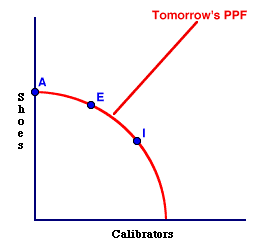
Let's consider a few alternatives. If we select bundle A (450 jogging shoes and 0 calibrators), then we are not adding to the quantity of capital. If we are not expanding the quantity of our capital, then our fixed resources remain fixed and the production possibilities curve remains unchanged.- As such, tomorrow's production possibilities curve will look just like today's curve. There will be no growth and no shift in the curve.
|
|
|
|
|

|
|
TAX EFFICIENCY Taxes, mandatory payments used to finance government operations, inherently disrupt the allocation of resources. This disruption might be good, correcting an otherwise inefficient allocation caused by pollution or market control. However, for an already efficiency allocation, a tax creates and inefficient wedge between the demand price and the supply price. This tax is generally paid partially by buyers and partially by sellers, which the tax incidence. Inefficiency arises because a tax reduces the total amount of consumer surplus and producer surplus, which is deadweight loss.
Complete Entry | Visit the WEB*pedia |

|

|
YELLOW CHIPPEROON
[What's This?]
Today, you are likely to spend a great deal of time visiting every yard sale in a 30-mile radius hoping to buy either a velvet painting of Elvis Presley or a wall poster commemorating yesterday. Be on the lookout for broken fingernail clippers.
Your Complete Scope
This isn't me! What am I?
|

|
|
The word "fiscal" is derived from a Latin word meaning "moneybag."
|

|
|
"The time to repair the roof is when the sun is shining." -- John F. Kennedy, 35th U. S. president
|

|
BIF
Bank Insurance Fund
|

|
|
Tell us what you think about AmosWEB. Like what you see? Have suggestions for improvements? Let us know. Click the User Feedback link.
User Feedback
|

|