|
|
SPECIALIZATION: The condition in which resources are primarily devoted to specific tasks. This is one of THE most important and most fundamental notions in the study of economics. Civilized human beings have long recognized that limited resources can be more effectively used in the production the goods and services that satisfy unlimited wants and needs if those resources specialize. For example, three ice cream parlor workers, can be, in total, more productive if one runs the cash register, another scoops the ice cream, and a third adds the hot fudge topping. By devoting their energies to learning how to do their respective tasks really, really well, these three workers can produce more hot fudge sundaes than if each performed all required tasks.
Visit the GLOSS*arama
|
|


|

|
|
Lesson 8: Market Shocks | Unit 3: Single Shifts
|
Page: 9 of 20
|
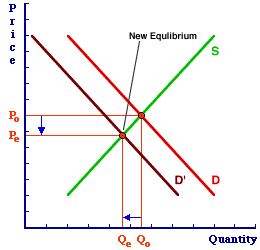
The six steps for a decrease in demand:- A determinant changes. The price of pecan pie, a substitute for hot fudge sundaes, declines.
- A curve to shifts. The demand curve for hot fudge sundaes shifts leftward.
- A shortage or a surplus occurs. The decrease in demand causes a surplus of hot fudge sundaes.
- The price changes. The price of hot fudge sundaes goes down.
- The quantities demanded and supplied change. The quantity supplied for hot fudge sundaes decreases while their quantity demand is increased.
- The market imbalance is eliminated and equilibrium is restored. The surplus of hot fudge sundaes is eliminated. The price is lower and the quantity exchanged is less.
|
|
|
|
|

|
|
CAPITALISM A type of economy, or economic system, based on--(1) private ownership of most resources, goods, and other assets; (2) freedom to generally use the privately-owned resources, goods, and other assets to get the most wages, rent, interest, and profit possible; and (3) a system of relatively competitive markets.
Complete Entry | Visit the WEB*pedia |

|

|
PURPLE SMARPHIN
[What's This?]
Today, you are likely to spend a great deal of time flipping through the yellow pages hoping to buy either a flower arrangement for that special day for your mother or a New York Yankees baseball cap. Be on the lookout for pencil sharpeners with an attitude.
Your Complete Scope
This isn't me! What am I?
|

|
|
The New York Stock Exchange was established by a group of investors in New York City in 1817 under a buttonwood tree at the end of a little road named Wall Street.
|

|
|
"Experience keeps a dear school, but fools will learn in no other. " -- Benjamin Franklin
|

|
FOMC
Federal Open Market Committee
|

|
|
Tell us what you think about AmosWEB. Like what you see? Have suggestions for improvements? Let us know. Click the User Feedback link.
User Feedback
|

|