|
|
DECLINE STAGE: The final stage of the product life cycle, characterized by a drastic drop off in profits. A company needs to decide how long to continue to support a product during this stage. Advertising and promotion can help maintain sales for a period of time. Ultimately, the cost-benefit tradeoff forces the business to discontinue the manufacturing of a product in this stage. Sometimes this happens quite rapidly and in some cases the product continues in this stage for many years.
Visit the GLOSS*arama
|
|


|

|
|
Lesson 10: Utility and Demand | Unit 4: On To Demand
|
Page: 15 of 21
|
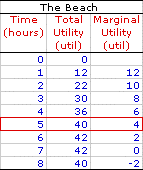
- A Higher Price
- Let's say that the price for going to the beach rises from $2 to $4 per hour. How is the quantity of my beach frolicking affected?
- The end result is that the higher price has reduced the quantity demanded of beach time.
- A Lower Price
- Let's say that the price for going to the beach falls $2 to $1.33 per hour. How is the quantity of my beach frolicking affected in this case?
- The end result is that a lower price has increased the quantity demanded of beach time.
|
|
|
|
|

|
|
ASYMMETRIC INFORMATION Information is not equally available to everyone. Asymmetric information results because efficient information search inevitably stops short of compete information. Some people obtain more benefits from information than others, are willing to incur higher search costs, and thus end up knowing more. Or they incur lower information search costs and have easier access to the information. In a market, sellers tend to have more information about the good than buyers. Asymmetric information gives rise to adverse selection, moral hazard, and the principal-agent problem. These problems can be lessened through signalling and screening.
Complete Entry | Visit the WEB*pedia |

|

|
RED AGGRESSERINE
[What's This?]
Today, you are likely to spend a great deal of time touring the new suburban shopping complex seeking to buy either a birthday gift for your grandmother or a T-shirt commemorating yesterday. Be on the lookout for cardboard boxes.
Your Complete Scope
This isn't me! What am I?
|

|
|
The New York Stock Exchange was established by a group of investors in New York City in 1817 under a buttonwood tree at the end of a little road named Wall Street.
|

|
|
"What gets measured gets done." -- Peter Drucker, educator
|

|
L/I
Letter of Intent
|

|
|
Tell us what you think about AmosWEB. Like what you see? Have suggestions for improvements? Let us know. Click the User Feedback link.
User Feedback
|

|