|
|
LABOR UNION MOVEMENT: Activities on the part of workers in the United States, beginning in the mid-1800s and extending into the mid-1900s, to establish labor unions and otherwise promote the interests of workers. This movement, which coincided with the onset of the U.S. industrial revolution, was launched with the Commonwealth versus Hunt court decision in 1842 which made it legal to join a labor union. The labor union movement had a turbulent and violent history as organized labor sought to gain greater control over labor market activities. The movement reached its peak in the 1950s, with just under 30% of the labor force belonging to labor unions.
Visit the GLOSS*arama
|
|


|

|
|
Lesson 14: Production | Unit 3: Product Curves
|
Page: 11 of 25
|
|
Topic:
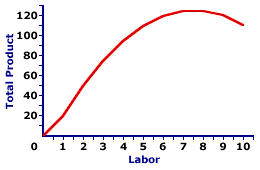
Total Product Curve
|
|
|
- The total product curve.
- The total product curve that graphically represents the relation between total production by a firm in the short run and the quantity of a variable input added to a fixed input.
|
|
|
|
|

|
|
AGGREGATE DEMAND DECREASE, LONG-RUN AGGREGATE MARKET A shock to the long-run aggregate market caused by a decrease in aggregate demand resulting in and illustrated by a leftward shift of the aggregate demand curve. A decrease in aggregate demand in the long-run aggregate market results in an increase in the price level but no change in real production. The level of real production resulting from the aggregate demand shock is full-employment real production.
Complete Entry | Visit the WEB*pedia |

|

|
|
The portrait on the quarter is a more accurate likeness of George Washington than that on the dollar bill.
|

|
|
"There's only one corner of the universe you can be certain of improving and that's your own self. " -- Aldous Huxley, writer
|

|
AACP
American Assocation of Commercial Publications
|

|
|
Tell us what you think about AmosWEB. Like what you see? Have suggestions for improvements? Let us know. Click the User Feedback link.
User Feedback
|

|