|
|
LAGGING ECONOMIC INDICATOR: One of seven economic statistics that tend to move up or down a few months after the expansions and contractions of the business cycle. These statistics paint a pretty clear picture of what the economy was doing a few months back. Lagging economic indicators lag the turning points of the aggregate economy by 3-12 months. After a contraction begins, lagging indicators decline 3 to 12 months later. And 3 to 12 months after a expansion begins, lagging indicators rise.
Visit the GLOSS*arama
|
|


|

|
|
Lesson 22: Factor Supply | Unit 3: Factor Supply
|
Page: 14 of 25
|
|
Topic:
Market Control Times Four
|
|
|
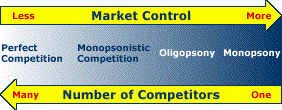
- Remember the four market structures with varying degrees of control over the supply-side of the market.
- HOWEVER, the demand side is also subject to varying degrees of control.
- The terminology for these very similar to that for supply-side control.
- Monopsony
- Oligopsony
- Monopsonistic Competition
- Perfect Competition
- Market control on the buying side of factors markets need not be related to the degree of market control on the selling side of product markets.
- However, it's not unusual to find comparable market control in both output and input markets.
|
|
|
|
|

|
|
INDUCED EXPENDITURES Expenditures on aggregate production by the four macroeconomic sectors that depend on income or production (especially national income or even gross domestic product). That is, changes in income generate changes in these expenditures. Each of the four aggregate expenditures--consumption, investment expenditures, government purchases, and net exports--have an induced component. Induced expenditures are measured by the slope of the aggregate expenditures line. The alternative to induced expenditures are autonomous expenditures, expenditures which do not depend on income.
Complete Entry | Visit the WEB*pedia |

|

|
BROWN PRAGMATOX
[What's This?]
Today, you are likely to spend a great deal of time at a dollar discount store trying to buy either a birthday greeting card for your father or a T-shirt commemorating the first day of spring. Be on the lookout for spoiled cheese hiding under your bed hatching conspiracies against humanity.
Your Complete Scope
This isn't me! What am I?
|

|
|
The 22.6% decline in stock prices on October 19, 1987 was larger than the infamous 12.8% decline on October 29, 1929.
|

|
|
"All labor that uplifts humanity has dignity and importance and should be undertaken with painstaking excellence. " -- Martin Luther King Jr., civil rights leader
|

|
SEHK
Stock Exchange of Hong Kong
|

|
|
Tell us what you think about AmosWEB. Like what you see? Have suggestions for improvements? Let us know. Click the User Feedback link.
User Feedback
|

|