|
|
MACRO GOALS: The three goals of a mixed economy that are most relevant to the study of macroeconomics are full employment, stability, and economic growth. Full employment is the condition in which all of the economy's available resources are engaged in the production of goods and services. Stability is the condition in which the economy avoids large changes in production, employment, and especially prices. Economic growth is the condition in which the economy's production possibilities are expanding over time.
Visit the GLOSS*arama
|
|


|

|
|
Lesson 7: Market Equilibrium | Unit 5: The Method
|
Page: 20 of 22
|
|
Topic:
Too Much Production
|
|
|
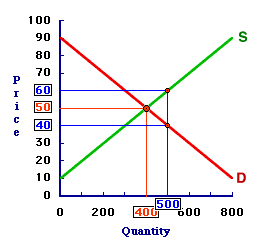
This market has a 50-cent price and a 400-tape quantity in equilibrium.- Note the demand price and the supply price if the quantity is 500 tapes.
- The demand price is 40 cents. This is the value of the good produced.
- The supply price is 60 cents. This is the value of goods not produced.
- Producing this quantity is the same as giving up 60 cents and getting 40 cents in return.
- 500 tapes is not an efficient use of resources
|
|
|
|
|

|
|
VALUE IN EXCHANGE The ability to trade an item or asset, especially money, for other goods and services that can then be used to satisfy wants and needs. Value in exchange means that value (that is, satisfaction) is obtained indirectly through the acquisition of something else. For an item to have value in exchange it need NOT have value in use, value obtained directly from the consumption of a good or service.
Complete Entry | Visit the WEB*pedia |

|

|
BLUE PLACIDOLA
[What's This?]
Today, you are likely to spend a great deal of time at a flea market hoping to buy either a birthday greeting card for your grandmother or a coffee cup commemorating yesterday. Be on the lookout for vindictive digital clocks with revenge on their minds.
Your Complete Scope
This isn't me! What am I?
|

|
|
During the American Revolution, the price of corn rose 10,000 percent, the price of wheat 14,000 percent, the price of flour 15,000 percent, and the price of beef 33,000 percent.
|

|
|
"Experience keeps a dear school, but fools will learn in no other. " -- Benjamin Franklin
|

|
IBB
International Bank Bonds
|

|
|
Tell us what you think about AmosWEB. Like what you see? Have suggestions for improvements? Let us know. Click the User Feedback link.
User Feedback
|

|