|
|
FACTOR DEMAND ELASTICITY: The elasticity of a factor demand curve is affected by four things: (1) the price elasticity of demand for the good produced, (2) the production function technology and elasticity of marginal physical product, (3) the ease of factor substitutability, and (4) the share of the factor's cost relative to total cost. Changes in any of these four items can cause the price elasticity of factor demand to change. In other words, the quantity of factor services demanded will become more or less sensitive to changes in the factor price.
Visit the GLOSS*arama
|
|


|

|
                           LONG-RUN TOTAL COST: The opportunity cost incurred by all of the factors of production used in the long run (when all inputs are variable) by a firm to produce a good or service, including wages paid to labor, rent paid for the land, interest paid to capital owners, and a normal profit earned by entrepreneurs. Unlike short-run total cost, long-run total cost cannot be separated into fixed cost and variable cost. In the long run, all inputs are variable, so all cost is variable. Long-run total cost is the total cost incurred by a firm in production when all inputs are variable. In particular, it is the per unit cost that results as a firm increases in the scale of operations by not only adding more workers to a given factory but also by building a larger factory.Not the Short RunIn the long run, when all inputs under the control of the firm are variable, there is no fixed cost. As such, there is no need to distinguish between total cost, fixed cost, and variable cost. In the long run, total cost is merely total cost. With no fixed inputs in the long run, increasing and decreasing marginal returns, and especially the law of diminishing marginal returns, are not relevant to long-run total cost. There are, however, two similar influences, economies of scale (or increasing returns to scale) and diseconomies of scale (or decreasing returns to scale). - The Short Run: In the short run, total cost increases at a decreasing rate due to increasing marginal returns and increases at an increasing rate due to decreasing marginal returns and the law of diminishing marginal returns. This also triggers changes in marginal cost.
- The Long Run: In the long run, there are no fixed inputs. As such, marginal returns and especially the law of diminishing marginal returns do not operate and thus do not guide production and cost. Instead long-run total cost is affected by increasing and decreasing returns to scale, which translates into economies of scale and diseconomies of scale.
Scale EconomiesLong-run total cost is guided by scale economies and returns to scale. - Economies of Scale: For relatively small levels of production, a firm tends to experience economies of scale and increasing returns to scale. These result because an increase in the scale of operations (a proportional increase in all inputs under the control of the firm) affects the cost of production.
- Diseconomies of Scale: For relatively large levels of production, a firm tends to experience diseconomies of scale and decreasing returns to scale. These result because an increase in the scale of operations affects the cost of production.
An S-shaped Curve| Long-Run Total Cost Curve | 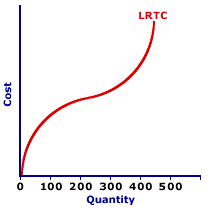 |
The shape of the long-run total cost curve displayed in this exhibit is S-shaped, much like a short-run total cost curve. For relatively small quantities of output, the slope begins to flatten. Then for larger quantities the slope makes a turn-around and becomes steeper. This shape, however, is NOT the result of increasing, then decreasing marginal returns that surface when a variable input is added to a fixed input in the short run.The flattening portion of this long-run total cost curve is attributable to economies of scale or increasing returns to scale. The steepening portion is then largely due to diseconomies of scale or decreasing returns to scale. No fixed inputs under the control of the firm are in operation. Two More CurvesLong-run cost is reflected by three curves. In addition to the long-run total cost curve, there is the long-run average cost curve and the long-run marginal cost curve. Each has a similar interpretation in the long run as the short run.- Long-run Average Cost: This curve graphically illustrates the relation between long-run average cost, which is the per unit cost incurred by all of the factors of production used in the long run by a firm to produce a good or service, and the level of production.
- Long-run Marginal Cost: This curve graphically illustrates the relation between long-run marginal cost, which is the change in the long-run total cost of producing a good or service resulting from a change in the quantity of output produced, and the level of production. It is also the slope of the long-run total cost curve.
For most analyses of long-run production and cost, the long-run total cost curve is lurking behind the scenes. The attention is primarily focused on the long-run average cost curve, and to a lesser extent the long-run marginal cost curve. However, it should be obvious that if there is an average and a marginal, somewhere along the line there is also a total.
Recommended Citation:LONG-RUN TOTAL COST, AmosWEB Encyclonomic WEB*pedia, http://www.AmosWEB.com, AmosWEB LLC, 2000-2025. [Accessed: July 18, 2025].
Check Out These Related Terms... | | | | | | |
Or For A Little Background... | | | | | | | | | | | | |
And For Further Study... | | | | | | | |
Search Again?
Back to the WEB*pedia
|

|

|
YELLOW CHIPPEROON
[What's This?]
Today, you are likely to spend a great deal of time searching the newspaper want ads trying to buy either a T-shirt commemorating the 2000 Olympics or a genuine fake plastic Tiffany lamp. Be on the lookout for telephone calls from former employers.
Your Complete Scope
This isn't me! What am I?
|

|
|
A lump of pure gold the size of a matchbox can be flattened into a sheet the size of a tennis court!
|

|
|
"A winner is someone who recognizes his God-given talents, works his tail off to develop them into skills, and uses those skills to accomplish his goals. " -- Larry Bird, basketball player
|

|
SSAP
Statement of Standard Accounting Practice
|

|
|
Tell us what you think about AmosWEB. Like what you see? Have suggestions for improvements? Let us know. Click the User Feedback link.
User Feedback
|

|