|
|
ABSTRACTION: Simplifying the complexities of the real world by ignoring (hopefully) unimportant details while doing economic analysis. Abstraction is often criticized because it's, well, it's JUST NOT REALISTIC. However, when done correctly (ignoring things that JUST DON'T MATTER), then the pursuit of knowledge is greatly enhanced by abstraction. For example, when travelling cross country along a high-speed interstate highway, a paper road map is a handy tool. It shows towns and cities along the way, the major intersections, rest stop locations, and other important points of interest. However, it ignores unimportant details. It doesn't realistically show the location of every tree, bush, or blade of grass. Why bother? This information won't enhance your road trip.
Visit the GLOSS*arama
|
|


|

|
|
Lesson 10: Gross Domestic Product | Unit 1: Measuring Production
|
Page: 1 of 25
|
Economists use numerical measurements to indicate the health and well-being of the economy.- Economic diagnosis relies on several indicators.
- Gross domestic product is the most comprehensive measure of the economy's production and one of the most basic measures of the economy's well-being.
- Gross domestic product, as well as other economic measures, are indicators of our economic health.
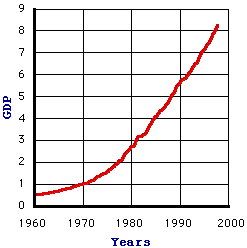
A GDP Definition:Gross domestic product (GDP) is the total market value of all final goods and services produced in the economy in a given period of time, usually one year. - The goal of GDP is to measure the total production of goods and services produced in the economy each year.
- A larger GDP means that we have more goods and services that can be used to satisfy our unlimited wants and needs.
- The chart presents recent numbers for GDP in the United States.
|
|
|
|
|

|
|
AVERAGE REVENUE, MONOPOLISTIC COMPETITION The revenue received for selling a good per unit of output sold, found by dividing total revenue by the quantity of output. Average revenue often goes by a simpler and more widely used term... price. For a monopolistically competitive firm average revenue is greater than marginal revenue. Average revenue for a monopolistically competitive firm is often depicted by a negatively-sloped average revenue curve.
Complete Entry | Visit the WEB*pedia |

|

|
WHITE GULLIBON
[What's This?]
Today, you are likely to spend a great deal of time at a garage sale trying to buy either a coffee cup commemorating the 2000 Olympics or a birthday gift for your grandmother. Be on the lookout for empty parking spaces that appear to be near the entrance to a store.
Your Complete Scope
This isn't me! What am I?
|

|
|
Parker Brothers, the folks who produce the Monopoly board game, prints more Monopoly money each year than real currency printed by the U.S. government.
|

|
|
"It is not because things are difficult that we do not dare; it is because we do not dare that they are difficult. " -- Seneca, statesman, dramatist, philosopher
|

|
WPO
Weakly Pareto Optimal
|

|
|
Tell us what you think about AmosWEB. Like what you see? Have suggestions for improvements? Let us know. Click the User Feedback link.
User Feedback
|

|