|
|
GOLD CERTIFICATE: Paper currency issued by the U. S. Treasury from the civil war until 1933 that could be exchanged for an equal value of gold. Gold certificates were used as part of a gold standard. With the exception of collectors, gold certificates have long been out of circulation, replaced first by silver certificates, then in the past few decades by Federal Reserve notes.
Visit the GLOSS*arama
|
|


|

|
                           TOTAL PRODUCT CURVE: A curve that graphically represents the relation between total production by a firm in the short run and the quantity of a variable input added to a fixed input. When constructing this curve, it is assumed that total product changes from changes in the quantity of a variable input (like labor), while other inputs (like capital) are fixed. This is one of three key product curves used in the analysis of short-run production. The other two are marginal product curve and average product curve. The total product curve illustrates how total product is related to a variable input. While the standard analysis of short-run production relates total product to the variable use of labor, a total product curve can be constructed for any variable input. A more general mathematical concept capturing the relation between total product and its assorted inputs, both variable and fixed, can be found in the production function.| Total Product Curve | 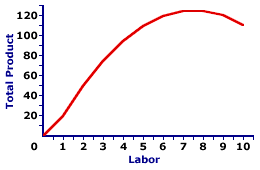 |
The graph at the right pictorially represents the relation between total product and the variable input. This particular curve is the hourly production of Super Deluxe TexMex Gargantuan Tacos (with sour cream and jalapeno peppers) as Waldo's TexMex Taco World restaurant employs additional workers. The number of workers, measured on the horizontal axis, ranges from 0 to 10 and the total production of Gargantuan Tacos, measured on the vertical axis, ranges from 0 to 125.The most distinctive feature is the shape of this total product curve. The curve emerges steeply from the origin (no workers produce no tacos), then begins to flatten, and eventually drops off. The curve reaches its peak of 125 Gargantuan Tacos at both 7 and 8 workers. To the left of this peak, extra workers increase the production of tacos and to the right extra workers reduce total taco production. While it might not be totally obvious from the diagram, the slope of this curve becomes increasingly steeper for the first two workers, then gradually flattens for the next five workers before finally turning negative. The changing slope of this curve is the direct result of increasing marginal returns that gives way to decreasing marginal returns and the law of diminishing marginal returns. One reason to take note of the shape of this curve is that other "natural" relations, both within economics and beyond, follow a similar pattern. A graph of the total utility derived from the consumption of several Hot Momma Fudge Bananarama Ice Cream Sundaes has a similar shape. So too does the plot of a person's life cycle of total income by age. In fact, this curve can be used to represent the life cycle of many natural phenomena, such as the growth of a tree, the public's adoption of a new product innovation, or the number of weeds in Duncan Thurly's backyard as spring days turn to summer.
Recommended Citation:TOTAL PRODUCT CURVE, AmosWEB Encyclonomic WEB*pedia, http://www.AmosWEB.com, AmosWEB LLC, 2000-2025. [Accessed: July 18, 2025].
Check Out These Related Terms... | | | | | | | | | |
Or For A Little Background... | | | | | | | | | | | | | |
And For Further Study... | | | | | | | | | | |
Search Again?
Back to the WEB*pedia
|

|

|
BROWN PRAGMATOX
[What's This?]
Today, you are likely to spend a great deal of time browsing through a long list of dot com websites seeking to buy either a case of blank recordable DVDs or a pair of red goulashes with shiny buckles. Be on the lookout for mail order catalogs with hidden messages.
Your Complete Scope
This isn't me! What am I?
|

|
|
Before 1933, the U.S. dime was legal as payment only in transactions of $10 or less.
|

|
|
"A winner is someone who recognizes his God-given talents, works his tail off to develop them into skills, and uses those skills to accomplish his goals. " -- Larry Bird, basketball player
|

|
RATS
Regression Analysis of Time Series (software)
|

|
|
Tell us what you think about AmosWEB. Like what you see? Have suggestions for improvements? Let us know. Click the User Feedback link.
User Feedback
|

|