|
|
JOHN MAYNARD KEYNES: A British economist (born 1883, died 1946) who is most noted for his work The General Theory of Employment, Interest, and Money, published 1936. The The General Theory revolutionized economic theory of the day, forming the foundation of Keynesian economics and creating the modern study of macroeconomics. Keynes was a well-known and highly respected economist prior to publication of The General Theory, however, this revolutionary work guaranteed Keynes a place as one of the most influential economists of all time.
Visit the GLOSS*arama
|
|


|

|
|
Lesson 4: Production Possibilities | Unit 2: The Schedule
|
Page: 7 of 24
|
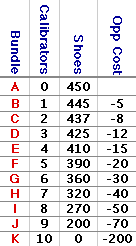
Opportunity cost is greater as we produce more calibrators. Why?- The law of increasing opportunity cost which says that the opportunity cost of producing a good increases as more and more of the good is produced.
- Third rule of inequality. All resources are not equally suited to produce all goods.
- First calibrator (A to B) uses resources best suited for calibrators and least suited for shoes.
- Tenth calibrator (J to K) uses resources least suited for calibrators and best suited for shoes.
- As more of a good is produced and supplied, opportunity cost increases.
|
|
|
|
|

|
|
AVERAGE-MARGINAL RELATION A mathematical connection between a marginal value and the corresponding average value stating that the change in the average value depends on a comparison between the average and the marginal. This mathematical relation between average and marginal surfaces throughout the study of economics, especially production (average product and marginal product), cost (average total cost and marginal cost), and revenue (average revenue and marginal revenue). A similar relation is that between a total value and the corresponding marginal value.
Complete Entry | Visit the WEB*pedia |

|

|
GRAY SKITTERY
[What's This?]
Today, you are likely to spend a great deal of time browsing through a long list of dot com websites trying to buy either rechargeable batteries or a rechargeable battery for your computer. Be on the lookout for door-to-door salesmen.
Your Complete Scope
This isn't me! What am I?
|

|
|
During the American Revolution, the price of corn rose 10,000 percent, the price of wheat 14,000 percent, the price of flour 15,000 percent, and the price of beef 33,000 percent.
|

|
|
"The only thing that will stop you from fulfilling your dreams is you. " -- Tom Bradley, former Los Angeles mayor
|

|
SDR
Special Drawing Right
|

|
|
Tell us what you think about AmosWEB. Like what you see? Have suggestions for improvements? Let us know. Click the User Feedback link.
User Feedback
|

|