|
|
JAWBONING: The use of verbal encouragement or discouragement by political leaders or other influential people to achieve particular results. This term was coined in reference to actions by President Lyndon Johnson in the 1960s. It is essentially an attempt by the President or other influential leaders to change public sentiment and move the economy in a particular direction without implementing or waiting for the results of formal economic policies. This also goes by the term moral suasion.
Visit the GLOSS*arama
|
|


|

|
                           AVERAGE PROPENSITY TO SAVE: The proportion of household income that is used for saving. The average propensity to save (abbreviated APS) is really nothing more than average saving. Together with the average propensity to consume, it indicates how a given level of income is divided between consumption and saving. A related saving measure is the marginal propensity to save. The average propensity to save (APS) indicates what the household sector does with income. The APS indicates the portion of income that is used for saving. If, for example, the APS is 0.1, then 10 percent of income goes for saving.The standard formula for calculating average propensity to save (APS) is: | Saving Schedule | 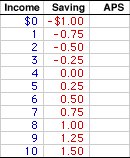
|
A saving schedule, such as the one presented to the right, provides data that can be used to run through a few APS calculations. The first column in this schedule presents household income, ranging from $0 to $10 trillion. The second column presents saving, ranging from -$1 to $1.5 trillion. The task at hand is to derive the average propensity to save at each income level.The average propensity to save is calculated by dividing saving in the second column by income in the first column. Beginning near the top of the schedule, if household income is $1 trillion, then saving is -$0.75 trillion, giving an average saving of -0.75. Running the numbers through the APS formula gives: | APS | = | saving
income | = | -$0.75
$1 | = | -0.75 |
Similar calculations can be performed for each income level. For example, if income from $4, then saving is also $0 trillion and the APS is equal 0 ($0/$4). If income is $8 trillion, the saving is $1 trillion and the APS is equal to 0.13 ($1/$8). To display all average propensity to save values, click the [APS] button.The prime conclusion from a quick look at the numbers is that APS increases as income increases. The APS is -0.75 for $1 trillion of income, then increases to 0.15 for $10 trillion of income. In other words, APS is not constant. The APS increases due to autonomous saving and induced saving. Autonomous saving is the -$1 trillion of saving that takes place if income is zero. Induced saving is the increase in saving that occurs due to an increase in income. Because saving is negative when income is zero, saving is necessarily less than income at low income levels, meaning the APS is less than one. Moreover, while saving is induced as income increases. The increase in saving increases the APS from its initial negative value into the positive range. The average propensity to save is one of four related measures. The other three are average propensity to consume, marginal propensity to save, and marginal propensity to consume. - Average Propensity to Consume: This is the proportion of household income that is used for consumption. Abbreviated APC, this is really nothing more than average consumption. Together with the average propensity to save, it indicates how a given level of income is divided between consumption and saving.
- Marginal Propensity to Save: This is the change in saving resulting from a change in income. Abbreviated MPS, this indicates the proportion of additional household income that is used for saving. It is the flip side of the marginal propensity to consume, and thus also quantifies the fundamental psychological law. The MPS is the slope of the saving line, which enters into the injections-leakages model. The multiplier is also related to the MPS.
- Marginal Propensity to Consume: This is the change in saving resulting from a change in income. Abbreviated MPC, this indicates the proportion of additional household income that is used for saving. It quantifies the fundamental psychological law and is the most important of these four measures. The MPC is the slope of the saving line, key to the slope of the aggregate expenditures line, and affects the magnitude of the multiplier.
Recommended Citation:AVERAGE PROPENSITY TO SAVE, AmosWEB Encyclonomic WEB*pedia, http://www.AmosWEB.com, AmosWEB LLC, 2000-2025. [Accessed: July 18, 2025].
Check Out These Related Terms... | | | | | | | |
Or For A Little Background... | | | | | | | | | | | | | |
And For Further Study... | | | | | | | | | | | | | | | | | | |
Search Again?
Back to the WEB*pedia
|

|

|
PURPLE SMARPHIN
[What's This?]
Today, you are likely to spend a great deal of time flipping through mail order catalogs trying to buy either a flower arrangement for your aunt or a birthday greeting card for your uncle. Be on the lookout for rusty deck screws.
Your Complete Scope
This isn't me! What am I?
|

|
|
During the American Revolution, the price of corn rose 10,000 percent, the price of wheat 14,000 percent, the price of flour 15,000 percent, and the price of beef 33,000 percent.
|

|
|
"A winner is someone who recognizes his God-given talents, works his tail off to develop them into skills, and uses those skills to accomplish his goals. " -- Larry Bird, basketball player
|

|
FY
Fiscal Year
|

|
|
Tell us what you think about AmosWEB. Like what you see? Have suggestions for improvements? Let us know. Click the User Feedback link.
User Feedback
|

|