|
|
LIFESTYLES: The opinions, activities, and interests that an individual expresses through his or her pattern of living. People tend to spend their time in certain ways and with certain types of people. These tendencies of interactions with others and utilization of time strongly affect many components of consumer behavior and subsequent decisions to purchase or not. Lifestyle patterns influence product needs, brand preferences, where people shop, and types of media that are effective to reach consumers.
Visit the GLOSS*arama
|
|


|

|
|
Lesson 4: Production Possibilities | Unit 2: The Schedule
|
Page: 5 of 24
|
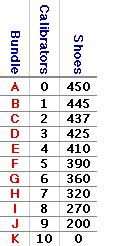
This is a simple, hypothetical production possibilities schedule for the economy.- The economy is using all resources with given technology to efficiently produce two goods, jogging shoes and quartz clock calibrators.
- Bundles A through K represent production alternatives for the economy, such as bundle D with 3 calibrators and 425 pairs of shoes. We have unlimited possibilities using available resources and technology to the fullest extent.
- All shoes, no calibrators, bundle A.
- All calibrators, no shoes, bundle K.
- Some of each good, bundles E or J.
- How about 9 calibrators and 410 pairs of shoes? No! Each bundle is the maximum we can produce.
|
|
|
|
|

|
|
AGGREGATE DEMAND DECREASE, SHORT-RUN AGGREGATE MARKET A shock to the short-run aggregate market caused by a decrease in aggregate demand, resulting in and illustrated by a leftward shift of the aggregate demand curve. A decrease in aggregate demand in the short-run aggregate market results in a decrease in the price level and a decrease in real production. The level of real production resulting from the shock can be greater or less than full-employment real production.
Complete Entry | Visit the WEB*pedia |

|

|
PURPLE SMARPHIN
[What's This?]
Today, you are likely to spend a great deal of time visiting every yard sale in a 30-mile radius trying to buy either a replacement battery for your pocket calculator or a how-to book on home remodeling. Be on the lookout for crowded shopping malls.
Your Complete Scope
This isn't me! What am I?
|

|
|
Junk bonds are so called because they have a better than 50% chance of default, carrying a Standard & Poor's rating of CC or lower.
|

|
|
"Lord, where we are wrong, make us willing to change; where we are right, make us easy to live with. " -- Peter Marshall, US Senate chaplain
|

|
NLLS
Nonlinear Least Squares
|

|
|
Tell us what you think about AmosWEB. Like what you see? Have suggestions for improvements? Let us know. Click the User Feedback link.
User Feedback
|

|