|
|
NATURAL MONOPOLY: A special type of monopoly that's able to lower its price when it produces and sells a larger quantity. This somewhat remarkable ability results because a natural monopoly uses a great deal of capital. In that capital carries an up front cost that must be paid regardless of production, a natural monopoly can spread these costs over larger quantity--if it produces more. The larger the quantity sold, the lower the cost for each unit. A single natural monopoly is thus able to produce and supply a good at a lower cost, and price, than two or more firms. In other words, if two or more firms try to supply the same good, the market will "naturally" end up with just one.
Visit the GLOSS*arama
|
|


|

|
                           EXCESS DEMAND: A disequilibrium condition in a competitive market in which the quantity demanded is greater than the quantity supplied. Excess demand is another way to say shortage. It also goes by the common term of sellers' market. Excess demand is one of two disequilibrium states of the market. The other is excess supply (or surplus). Excess demand emerges in a market when the quantity demanded by the buyers exceeds the quantity supplied by the sellers... at a given market price. Buyers are seeking to buy more of the good than sellers are willing to sell, hence there is an "extra" or "excess" amount of demand.| Excess Demand | 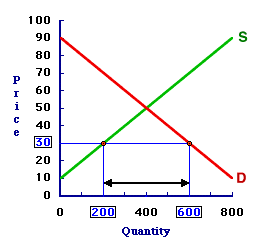 |
Excess demand is illustrated using the market for 8-track tapes displayed in this exhibit. This graph was generated with data from the 88th Annual Trackmania 8-Track Tape Collectors Convention at the Shady Valley Exposition Center.The excess demand for 8-track tapes is indicated as the difference between the quantity demanded and the quantity supplied at a specific market price. In particular, at a 30-cent price, the quantity demanded is 600 tapes and the quantity supplied is 200 tapes. Buyers are willing and able to purchase 400 tapes more than sellers are willing and able to sell. Hence this market has an excess demand of 400 tapes. The result of this excess demand is an increase in the market price. Because buyers are unable to buy as much of the good as they want, they are inclined to bid up the price. Of course, as the price rises, the quantity supplied increases and the quantity demanded decreases, both acting to reduce the amount of the excess demand. Ultimately the entire excess demand is eliminated and equilibrium is restored.
Recommended Citation:EXCESS DEMAND, AmosWEB Encyclonomic WEB*pedia, http://www.AmosWEB.com, AmosWEB LLC, 2000-2025. [Accessed: July 18, 2025].
Check Out These Related Terms... | | | | | | | |
Or For A Little Background... | | | | | | | | | |
And For Further Study... | | | | | | | |
Search Again?
Back to the WEB*pedia
|

|

|
YELLOW CHIPPEROON
[What's This?]
Today, you are likely to spend a great deal of time searching the newspaper want ads trying to buy either a T-shirt commemorating the 2000 Olympics or a genuine fake plastic Tiffany lamp. Be on the lookout for telephone calls from former employers.
Your Complete Scope
This isn't me! What am I?
|

|
|
There were no banks in colonial America before the U.S. Revolutionary War. Anyone seeking a loan did so from another individual.
|

|
|
"A winner is someone who recognizes his God-given talents, works his tail off to develop them into skills, and uses those skills to accomplish his goals. " -- Larry Bird, basketball player
|

|
OSE
Osaka Securities Exchange (Japan)
|

|
|
Tell us what you think about AmosWEB. Like what you see? Have suggestions for improvements? Let us know. Click the User Feedback link.
User Feedback
|

|