|
|
LOAN LOSS RESERVES: A special account set aside by banks acting as a buffer between deposits and net worth that's used in case a loan is not repaid. Without this reserve, an unpaid loan on the asset side of a bank's balance sheet would require an adjustment of deposits or net worth on the liability side. The loan loss reserve is used for this adjustment.
Visit the GLOSS*arama
|
|


|

|
                           AVERAGE REVENUE CURVE, MONOPOLISTIC COMPETITION: A curve that graphically represents the relation between average revenue received by a monopolistically competitive firm for selling its output and the quantity of output sold. Because average revenue is essentially the price of a good, the average revenue curve is also the demand curve for a monopolistically competitive firm's output. Monopolistic competition is a market structure with a large number of relatively small firms that sell similar but not identical products. Each firm is small relative to the overall size of the market such that it has some market control, but not much. In other words, it can sell a wide range of output at a narrow range of prices. This translates into a relatively elastic demand curve. If a monopolistically competitive firm wants to sell a larger quantity, then it must lower the price.The average revenue curve reflects the degree of market control held by a firm. For a perfectly competitive firm with no market control, the average revenue curve is a horizontal line. For firms with market control, such as monopolistic competition, the average revenue curve is negatively-sloped. Average Revenue Curve,
Sandwich Style | 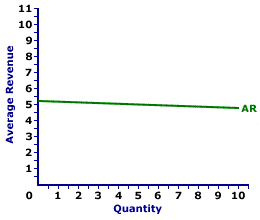 |
The average revenue curve for Manny Mustard is displayed in the exhibit to the right. Key to this curve is that Manny Mustard is a monopolistically competitive seller of sandwiches and thus faces a negatively-sloped demand curve. Larger quantities of output are only possible with lower prices.The vertical axis measures average revenue and the horizontal axis measures the quantity of output (number of sandwiches). Although quantity on this particular graph stops at 10 sandwiches, it could go higher. This curve indicates that if Manny Mustard sells 1 sandwich (at $5.20 per sandwich), then average revenue is $5.20 per sandwich. Alternatively, if he sells 10 sandwiches (at $4.75 per sandwich), then average revenue in is $4.75 per sandwich. For Manny Mustard the average revenue curve is also the demand curve. The curve is negatively sloped, meaning that larger quantities of output result in less average revenue. Although this average revenue curve, and preceding table of average revenue numbers, is based on the production activity of Manny Mustard, a well-known monopolistically competitive firm, they apply to any firm with market control. Monopoly and oligopoly firms that also face negatively-sloped demand curves generate comparable average revenues.
Recommended Citation:AVERAGE REVENUE CURVE, MONOPOLISTIC COMPETITION, AmosWEB Encyclonomic WEB*pedia, http://www.AmosWEB.com, AmosWEB LLC, 2000-2025. [Accessed: June 30, 2025].
Check Out These Related Terms... | | | | | | | | |
Or For A Little Background... | | | | | | | | | | | |
And For Further Study... | | | | | | | | |
Related Websites (Will Open in New Window)... | | | |
Search Again?
Back to the WEB*pedia
|

|

|
YELLOW CHIPPEROON
[What's This?]
Today, you are likely to spend a great deal of time flipping through mail order catalogs looking to buy either income tax software or a how-to book on the art of negotiation. Be on the lookout for fairy dust that tastes like salt.
Your Complete Scope
This isn't me! What am I?
|

|
|
More money is spent on gardening than on any other hobby.
|

|
|
"I learned about the strength you can get from a close family life. I learned to keep going, even in bad times. I learned not to despair, even when my world was falling apart. I learned that there are no free lunches. And I learned the value of hard work. " -- Lee Iacocca
|

|
JRE
Journal of Regulatory Economics
|

|
|
Tell us what you think about AmosWEB. Like what you see? Have suggestions for improvements? Let us know. Click the User Feedback link.
User Feedback
|

|