
|
|
UNFAIR LABOR PRACTICE: An activity on the part of employers to discourage legal labor union actions or on the part of labor unions to discourage legal nonunion employee actions. In the never ending battle between labor and management to gain the upper hand in the labor market each side has engaged in practices to thwart the power of the other side. Management commonly undertook what are now termed unfair labor practices in the early stages of the labor union movement to prevent unions from gaining power. Once unions gained power, however, then too engaged in unfair labor practices to keep and enhance that power. Unfair labor practices by management were largely outlawed by the National Labor Relations Act. Unfair labor practices by labor unions were largely outlawed by the Taft-Hartley Act.
Visit the GLOSS*arama
|
|


|

|
                           DEMAND SHOCK: A disruption of market equilibrium caused by a change in a demand determinant and a shift of the demand curve. A demand shock can take one of two forms--a demand increase or a demand decrease. This is one of two disruptions of the market. The other is a supply shock. A demand shock to the market results when the demand curve is shifted due to a change in one of the five demand determinants--buyers' income, buyers' preferences, other prices, buyers' expectations, and number of buyers.The demand shock comes in two varieties. - Increase in Demand: This is a rightward shift of the demand curve. It generates an increase in the equilibrium price and an increase in the equilibrium quantity.
- Decrease in Demand: This is a leftward shift of the demand curve. It generates a decrease in the equilibrium price and a decrease in the equilibrium quantity.
Demand IncreaseAn increase in demand can result from a change in any of the five demand determinants. - Buyers' Income: An increase in buyers' income for a normal good or a decrease in buyers' income for an inferior good.
- Buyers' Preferences: An increase in buyers' preferences for the good.
- Buyers' Preferences: An increase in the price of a substitute-in-consumption or a decrease in the price of a complement-in-consumption.
- Buyers' Expectations: Expectations by buyers of an increase in the price in the future.
- Number of Buyers: An increase in the number of buyers in the market.
| Increase in Demand | 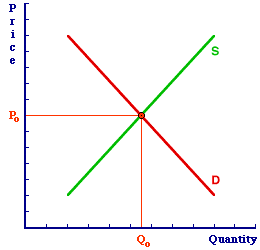 |
The comparative static analysis of an increase in demand is illustrated in the exhibit at the right. The market is disrupted when one of the five demand determinants listed above causes an increase in demand and a rightward shift of the demand curve. This can be seen by clicking the "demand increase" button. The result of this disruption, given the original equilibrium price, is a temporary shortage (click the [Shortage] button). The shortage then induces an increase in the price (click the [Price Increase] button). The price increase causes an increase in quantity supplied and a decrease in quantity demanded. The result of these quantity changes is a new equilibrium at a higher price and a larger quantity. Click the [New Equilibrium] button to display this outcome. The comparative static analysis reveals an increase in the equilibrium price and an increase in the equilibrium quantity. An increase in demand results in an increase in the equilibrium quantity. The demand shift means that buyers want to buy more. Sellers are willing to accommodate buyers. However, to appease their increased demand, sellers must charge a higher price to cover their increasing production cost in accordance with the law of supply. Demand DecreaseAn decrease in demand can result from a change in any of the five demand determinants. - Buyers' Income: A decrease in buyers' income for a normal good or an increase in buyers' income for an inferior good.
- Buyers' Preferences: A decrease in buyers' preferences for the good.
- Buyers' Preferences: A decrease in the price of a substitute-in-consumption or an increase in the price of a complement-in-consumption.
- Buyers' Expectations: Expectations by buyers of a decrease in the price in the future.
- Number of Buyers: A decrease in the number of buyers in the market.
| Decrease in Demand | |
The comparative static analysis of a decrease in demand is illustrated in the exhibit at the right. The market is disrupted when one of the five demand determinants listed above causes a decrease in demand and a leftward shift of the demand curve. This can be seen by clicking the [Demand Decrease] button. The result of this disruption, given the original equilibrium price, is a temporary surplus (click the [Surplus] button). The surplus then induces a decrease in the price (click the [Price Decrease] button). The price decrease causes a decrease in quantity supplied and an increase in quantity demanded. The result of these quantity changes is a new equilibrium at a lower price and a smaller quantity. Click the [New Equilibrium] button to display this outcome. The comparative static analysis reveals a decrease in the equilibrium price and a decrease in the equilibrium quantity. A decrease in demand results in a decrease in the equilibrium quantity. The demand shift means that buyers want to buy less. Sellers are willing to accommodate buyers. However, to appease their decreased demand, sellers are able to charge a lower price to cover their decreasing production cost in accordance with the law of supply. Summarizing the Changes| Shift | Quantity
Change | Price
Change | | Demand Increase | Increase | Increase | | Demand Decrease | Decrease | Decrease |
Comparative static results of the two demand shocks are summarized in the table at the right. A key observation is that equilibrium quantity moves in the SAME direction as the change in demand. If demand increases, then equilibrium quantity increases. If demand decreases and quantity demanded decreases.However, because the supply curve does NOT shift, the market is constrained to move ALONG the supply curve and follow the law of supply. If the quantity increases, then the price also increases. If the quantity decreases, then so too does the price.
Recommended Citation:DEMAND SHOCK, AmosWEB Encyclonomic WEB*pedia, http://www.AmosWEB.com, AmosWEB LLC, 2000-2025. [Accessed: July 3, 2025].
Check Out These Related Terms... | | | | | |
Or For A Little Background... | | | | | | | | | | | | |
And For Further Study... | | | | | | | |
Search Again?
Back to the WEB*pedia
|

|

|
GRAY SKITTERY
[What's This?]
Today, you are likely to spend a great deal of time at a going out of business sale looking to buy either a wall poster commemorating the 2000 Presidential election or a rechargeable flashlight. Be on the lookout for fairy dust that tastes like salt.
Your Complete Scope
This isn't me! What am I?
|

|
|
Ragnar Frisch and Jan Tinbergen were the 1st Nobel Prize winners in Economics in 1969.
|

|
|
"Far and away the best prize that life has to offer is the chance to work hard at work worth doing." -- Theodore Roosevelt, 26th US president
|

|
GSP
Gross State Product, Generalized System of Preferences
|

|
|
Tell us what you think about AmosWEB. Like what you see? Have suggestions for improvements? Let us know. Click the User Feedback link.
User Feedback
|

|






