|
|
ECONOMIC GROWTH: The long-run expansion of the economy's ability to produce output. This is one of five economic goals, specifically one of the three macro goals (stability and full employment are the other two). Economic growth is made possible by increasing the quantity or quality of the economy's resources (labor, capital, land, and entrepreneurship).
Visit the GLOSS*arama
|
|


|

|
                           MULTIPLIER, INJECTIONS-LEAKAGES MODEL: An analysis of the multiplier principle using the injections-leakages model intersection between the injections line and the leakages line. The injections-leakages model analysis illustrates the Keynesian multiplier as a shift of the injections line (or leakages line) and a subsequent change of the equilibrium level of aggregate production. This analysis illustrates the important role played the marginal propensity to consume (and save), which affects the slope of the leakages line. An alternate but comparable analysis of the multiplier principle is accomplished using the Keynesian cross. The multiplier principle is the notion that relatively small changes in autonomous expenditures or other shocks cause relatively large overall changes in aggregate production and income. The injections-leakages model provides a handy framework for illustrating this multiplier principle. The injections-leakages model is a graphical representation of Keynesian economics based on the intersection of the injections line comprised of investment expenditures, government purchases and exports, and the leakages line comprised of saving, taxes, and imports.The multiplier principle can be illustrated by a vertical shift in the injections line, if triggered by an autonomous expenditure change in investment expenditures, government purchases, or exports. It also can be illustrated by a vertical shift of the leakages line, if triggered by an autonomous change in saving, taxes, or imports. The slopes of the injections and leakages lines, which are based on the assorted induced activities, especially the marginal propensity to save (and consume), then determine the new equilibrium level of aggregate production and the magnitude of the change from the original equilibrium. An Investment ShiftThe essence of the multiplier process can be analyzed using the simple, two-sector injections-leakage, or the savings-investment model. This model is based on the balance between non-consumption expenditures that are injected into the main circular flow and non-consumption uses of income that are leaked out. The simplest injections-leakage model includes the two private sectors -- household and business -- with investment the only injection and saving the only leakage.| An Investment Shift | 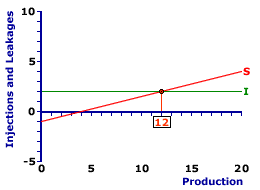
|
The exhibit to the immediate right presents the two-sector injections-leakages model. It can be used to analyze a shock caused by a $1 trillion change in investment expenditures.- To set up this analysis, note that the model contains two lines. The positively sloped line, S, is the saving (leakages) line. The horizontal line, I, is the investment (injections) line.
- The positive slope of the saving line is the marginal propensity to save and indicates that saving is induced by income. This slope is equal to 0.25. The horizontal investment line means that investment is autonomous and unaffected by income and aggregate production.
- The intersection of the two lines identifies equilibrium, which is $12 trillion of aggregate production. This is the initial equilibrium that exists before the autonomous investment expenditure change triggers the multiplier process.
The multiplier process is essentially a disruption of this equilibrium and the adjustment to a new equilibrium. Let's see how this equilibrium is affected by $1 trillion injection of investment expenditures.- This injection causes an upward shift of the investment line. To display this shift, click the [Injection] button. Because this is a change in autonomous investment, the new investment line is also horizontal and parallel to the original investment line.
- The new equilibrium is found by the intersection of the new investment line and the saving line. Click the [Equilibrium] button to highlight equilibrium. This equilibrium results in aggregate production of $16 trillion. The change in aggregate production is $4 trillion.
- The $4 trillion change in aggregate production is four times the initial $1 trillion injection of investment. This indicates that the multiplier is equal to 4.
The results obtained from analysis of the injections-leakages model are the same as those from an analysis of a comparable Keynesian aggregate expenditures model, that is the Keynesian cross. This occurs because the underlying structure is the same for both models. If consumption is the only induced expenditure, then the marginal propensity to consume and marginal propensity to save have the same values. The multiplier is equal to 4 for both. And both analyze the impact of a $1 trillion injection.
Recommended Citation:MULTIPLIER, INJECTIONS-LEAKAGES MODEL, AmosWEB Encyclonomic WEB*pedia, http://www.AmosWEB.com, AmosWEB LLC, 2000-2025. [Accessed: July 18, 2025].
Check Out These Related Terms... | | | | | | | | | |
Or For A Little Background... | | | | | | | | | | | | |
And For Further Study... | | | | |
Search Again?
Back to the WEB*pedia
|

|

|
BROWN PRAGMATOX
[What's This?]
Today, you are likely to spend a great deal of time browsing through a long list of dot com websites seeking to buy either a case of blank recordable DVDs or a pair of red goulashes with shiny buckles. Be on the lookout for mail order catalogs with hidden messages.
Your Complete Scope
This isn't me! What am I?
|

|
|
Three-forths of the gold mined each year is used to manufacture jewelry.
|

|
|
"A winner is someone who recognizes his God-given talents, works his tail off to develop them into skills, and uses those skills to accomplish his goals. " -- Larry Bird, basketball player
|

|
M1
currency and coins held by the nonbank public plus checkable deposits issued by traditional banks, savings and loan associations, credit unions, and mutual savings banks
|

|
|
Tell us what you think about AmosWEB. Like what you see? Have suggestions for improvements? Let us know. Click the User Feedback link.
User Feedback
|

|