|
|
ANDEAN COMMUNITY: The Andean Community (CAN) is a subregional organization endowed with an international legal status, which is made up of Bolivia, Colombia, Ecuador, Peru and Venezuela. The main objectives of the Andean Community are to promote the balanced and harmonious development of the member countries under equitable conditions, to boost their growth through integration and economic and social cooperation and to enhance participation in the regional integration process with a view to the progressive formation of a Latin American common market. The Andean Community started operating on August 1, 1997 with a General Secretariat, whose headquarters are in Lima (Peru), as its executive body.
Visit the GLOSS*arama
|
|


|

|
                           AGGREGATE SUPPLY DECREASE, LONG-RUN AGGREGATE MARKET: A shock to the long-run aggregate market caused by a decrease in aggregate supply, resulting in and illustrated by a leftward shift of the long-run aggregate supply curve. A decrease in aggregate supply in the long-run aggregate market results in an increase in the price level and a decrease in real production. The level of real production resulting from the shock is a smaller level of full-employment real production. While a wide range of specific aggregate supply determinants can cause a decrease in aggregate supply, the following rank among the more important:- A decline in the size of the population or a decrease in the labor force participation rate, both of which decrease the quantity of labor available for production.
- Depreciation of capital goods, which decreases the quantity of capital available for production.
- The depletion of existing mineral deposits or fossil fuels, both of which decrease the quantity of land resources available for production.
- A decrease in education which decreases the quality of labor resources.
- A decrease in technology which decreases the quality of capital resources.
Supply Decrease
Long-Run Aggregate Market | 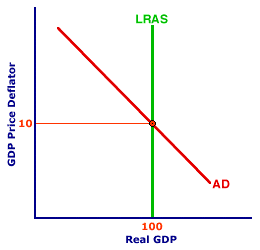
|
The long-run aggregate market presented in the graph to the right sets the stage for analyzing the effect of a decrease in aggregate supply resulting from a change in an aggregate supply determinant. The vertical axis measures the price level (GDP price deflator) and the horizontal axis measures real production (real GDP). The negatively-sloped curve, labeled AD, is the aggregate demand curve and the vertical curve, labeled LRAS, is the long-run aggregate supply curve. The current long-run equilibrium, found at the intersection of the AD and LRAS curves, is a price level of 10 and real production of $100 billion. This equilibrium level of real production is also full-employment real production.Consider what happens to this long-run aggregate market with a decrease in aggregate supply. Suppose, for example, that a dramatic depletion of energy reserves cause an equally dramatic decrease in land resources. The result of this is a leftward shift of the LRAS curve. Click the [LRAS Decrease] button to illustrate. The result of this leftward LRAS curve shift is that a new long-run equilibrium is achieved at a higher price level (12) and a smaller amount of real production ($80 billion). This result is comparable to that for a standard market. A decrease in market supply results in a higher equilibrium price and a smaller equilibrium quantity. The key difference, of course, is that this "market" is the aggregate product market for the entire economy and not the market for a specific good. A comparative static analysis of the original equilibrium and the new equilibrium is useful and important. However, it is also instructive to dissect the adjustment process. - First, the LRAS curve shifts leftward due to the depletion of energy resources. This reduction in aggregate supply creates an imbalance in the aggregate market. At the existing price level (which has NOT yet changed), buyers are willing and able to buy $100 billion worth of real production. Producers, however, are now willing and able to sell only $80 billion worth of real production. This creates economy-wide product market shortages.
- Second, motivated to fill these shortages, producers TRY to increase production. In the short run they can do so. But in the long run, they cannot. In the long run, wages and other resource prices are flexible. Wage increases are matched by equal increases in the price level. As such, labor and other resource markets remain in equilibrium, meaning full-employment production is supplied. The only result of attempts to increase production is a rising price level.
- Third, with the rising price level, buyers are induced to decrease aggregate expenditures. The decrease in aggregate expenditures acts to reduce the existing economy-wide product market shortages. In fact, as long as economy-wide product market shortages persist, the price level rises and aggregate expenditures decline. This continues until aggregate expenditures exactly match full-employment production. The end result is the new long-run equilibrium price level of 12 and full-employment real production of $80 billion.
Recommended Citation:AGGREGATE SUPPLY DECREASE, LONG-RUN AGGREGATE MARKET, AmosWEB Encyclonomic WEB*pedia, http://www.AmosWEB.com, AmosWEB LLC, 2000-2025. [Accessed: July 3, 2025].
Check Out These Related Terms... | | | | | | | | |
Or For A Little Background... | | | | | | | | | | | | | | | | |
And For Further Study... | | | | | | | | | |
Search Again?
Back to the WEB*pedia
|

|

|
PINK FADFLY
[What's This?]
Today, you are likely to spend a great deal of time lost in your local discount super center wanting to buy either galvanized steel storage shelves or a large green chalkboard shaped like the state of Maine. Be on the lookout for fairy dust that tastes like salt.
Your Complete Scope
This isn't me! What am I?
|

|
|
The wealthy industrialist, Andrew Carnegie, was once removed from a London tram because he lacked the money needed for the fare.
|

|
|
"Far and away the best prize that life has to offer is the chance to work hard at work worth doing." -- Theodore Roosevelt, 26th US president
|

|
ADV FRT
Advance Freight
|

|
|
Tell us what you think about AmosWEB. Like what you see? Have suggestions for improvements? Let us know. Click the User Feedback link.
User Feedback
|

|