|
|
SAVING-INVESTMENT EQUALITY: A classical economic proposition stating that flexible prices ensure an equality between saving and investment. This equality is essential to obtain the classical economic conclusion that unrestricted markets achieve and maintain full employment. This is one of the three assumptions underlying classical economics. The other two assumptions are flexible prices and Say's law.
Visit the GLOSS*arama
|
|


|

|
                           EQUILIBRIUM, SHORT-RUN AGGREGATE MARKET: The state of equilibrium that exists in the short-run aggregate market when real aggregate expenditures are equal to full-employment real production with no imbalances to induce changes in the price level or real production. The opposing forces of aggregate demand (the buyers) and short-run aggregate supply (the sellers) exactly offset each other. At the existing price level, the four macroeconomic sectors (household, business, government, and foreign) purchase all of the real production that they seek and producers sell all of the real production that they have. While the focus of equilibrium in the short-run aggregate market is on balance between real expenditures and real production in the product markets, it also involves simultaneous equilibrium in the aggregated financial markets but not in the aggregated resource markets. Short-run price rigidity means that resource markets are out of balance, with either surpluses (unemployment) or shortages (overemployment). Short-run equilibrium is one of two macroeconomic equilibrium alternatives found in aggregate market analysis. The other is equilibrium in the long-run aggregate market, which has equilibrium in all three aggregated markets--product, financial, and resource.Equilibrium
Short-Run Aggregate Market | 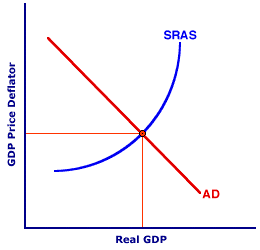 |
This graph to the right can be used to illustrate equilibrium in the short-run aggregate market. First, to set up the graph, the vertical axis measures the price level (GDP price deflator) and the horizontal axis measures real production (real GDP). The negatively-sloped curve, labeled AD, is the aggregate demand curve and the positively-sloped curve, labeled SRAS, is the short-run aggregate supply curve. Short-run equilibrium is the price level and real production obtained at the intersection of the AD and SRAS curves.Because the SRAS curve is positively-sloped, short-run equilibrium can occur at ANY level of real production. It need NOT be full employment. To demonstrate that short-run equilibrium can occur at different levels of real production should aggregate demand change, click the [AD Increase] and [AD Decrease] buttons. An increase in aggregate demand leads to a higher price level AND an increase in real production. A decrease in aggregate demand leads to a lower price level AND a decrease in real production. Short-run aggregate market equilibrium means the economy has no wide-spread shortages or surpluses in the product markets. However, this does not necessarily mean that ALL product markets are in equilibrium. A complex economy, like that in the United States, is bound to have shortages in some product markets and surpluses in others in short-run equilibrium. As such, prices in some markets rise, while those in other markets fall. These sorts of imbalances in specific markets reflect the ongoing reallocation of resources at the microeconomic level. What is required for aggregate market equilibrium at the macroeconomic level is that the microeconomic shortages and surpluses cancel out, that rising prices cancel falling prices, that the price level and real production do not change. By far the most important implication of short-run equilibrium is unemployment. Short-run price rigidity means that resource markets are out of balance, meaning either shortages or surpluses. In particular, there is some degree of cyclical unemployment or overemployment. This is why the SRAS curve is positively-sloped. At higher or lower price levels, real production can exceed or fall short of full-employment real production, resulting in overemployment or cyclical unemployment. And because short-run equilibrium can occur at ANY point on the SRAS curve, it need not be full employment. Another way of stating this is that the economy produces ANYTHING BUT full-employment real production in the short run. This implication of short-run full-employment is most important for government policies. If the economy is not producing full-employment real production in the short run, then stabilization policies from government can be used to improve the situation. The goal of stabilization policies is to achieve full employment. If the economy is not at full employment, then such policies can be useful. This role for government policies is warmly embraced by political liberals and others who prefer an active role for government in the economy.
Recommended Citation:EQUILIBRIUM, SHORT-RUN AGGREGATE MARKET, AmosWEB Encyclonomic WEB*pedia, http://www.AmosWEB.com, AmosWEB LLC, 2000-2025. [Accessed: June 30, 2025].
Check Out These Related Terms... | | | | | | | | |
Or For A Little Background... | | | | | | | | | | | | | | | | |
And For Further Study... | | | | | | | | | |
Search Again?
Back to the WEB*pedia
|

|

|
PURPLE SMARPHIN
[What's This?]
Today, you are likely to spend a great deal of time searching for rummage sales seeking to buy either a birthday greeting card for your mother that doesn't look like a greeting card or a handcrafted spice rack. Be on the lookout for vindictive digital clocks with revenge on their minds.
Your Complete Scope
This isn't me! What am I?
|

|
|
The first U.S. fire insurance company was established by Benjamin Franklin in 1752 in Philadelphia.
|

|
|
"I learned about the strength you can get from a close family life. I learned to keep going, even in bad times. I learned not to despair, even when my world was falling apart. I learned that there are no free lunches. And I learned the value of hard work. " -- Lee Iacocca
|

|
IIP
Index of Industrial Production
|

|
|
Tell us what you think about AmosWEB. Like what you see? Have suggestions for improvements? Let us know. Click the User Feedback link.
User Feedback
|

|