|
|
OPEN SHOP: An employment arrangement in which workers of a firm are free to join or not join a union because employment is unrelated to union membership. Because an open shop tends to limit the proportion of a firm's employees represented, this can significantly dilute a labor union's market control. Open shops are established in states that have right-to-work laws.
Visit the GLOSS*arama
|
|


|

|
                           INTERCEPT, INVESTMENT LINE: The intercept of the investment line indicates autonomous investment, investment that does not depend on the level of income or production. This can be thought of as investment that the business sector undertakes regardless of the state of the economy. Autonomous investment is affected by the investment expenditures determinants, which cause a change in the intercept and a shift of the investment line. | Investment Line | 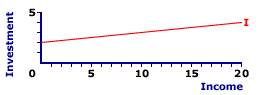
|
The investment line, also termed propensity-to-invest line or investment function, shows the relation between investment and income for the business sector. The income and production measures commonly used are national income and gross domestic product.A representative investment line is presented in the exhibit to the right. This red line, labeled I in the exhibit, is positively sloped, indicating that greater levels of income generate greater investment by the business sector. This positive relation indicates that the business sector is inclined to divert higher profits generated by an expanding economy to investment expenditures on capital goods. The investment line graphically illustrates the investment-income relation for the business sector, which is then added to the consumption line to derive the aggregate expenditures line used in Keynesian economics to identify equilibrium income and production. The intercept of the investment line indicates the intersection point between the investment line and the vertical investment axis. The investment line intersects the vertical axis at a value of $2 trillion. Theoretically, this is a minimum "baseline" level of investment, the amount of investment undertaken if income falls to zero. This intersection indicates autonomous investment--investment unrelated to income. Click the [Intercept] button to illustrate. Autonomous investment is investment by the business sector that is unrelated to and unaffected by the level of income or production. This is best indicated by a zero level of income. While individual businesses occasionally come face-to-face with autonomous investment, as their own slice of aggregate income drops to zero, for the aggregate economy autonomous investment is mostly an unlikely theoretical extrapolation. However, from an analytical perspective, the intercept of the investment line is affected by the investment expenditures determinants. These are ceteris paribus factors other than income that affect investment, but which are held constant when the investment line is constructed. Any change in these determinants cause the investment line to shift, which necessarily means a new intercept and a new level of autonomous investment.
Recommended Citation:INTERCEPT, INVESTMENT LINE, AmosWEB Encyclonomic WEB*pedia, http://www.AmosWEB.com, AmosWEB LLC, 2000-2025. [Accessed: July 18, 2025].
Check Out These Related Terms... | | | | | | | | | |
Or For A Little Background... | | | | | | | | | |
And For Further Study... | | | | | | | | | | | | | | |
Search Again?
Back to the WEB*pedia
|

|

|
|
Cyrus McCormick not only invented the reaper for harvesting grain, he also invented the installment payment for selling his reaper.
|

|
|
"A winner is someone who recognizes his God-given talents, works his tail off to develop them into skills, and uses those skills to accomplish his goals. " -- Larry Bird, basketball player
|

|
AIC
Akaike's Information Criterion
|

|
|
Tell us what you think about AmosWEB. Like what you see? Have suggestions for improvements? Let us know. Click the User Feedback link.
User Feedback
|

|