|
|
KEYNESIAN THEORY: A theory of macroeconomics developed by John Maynard Keynes built on the proposition that aggregate demand is the primary source of business cycle instability, especially recessions. The basic structure of the Keynesian theory of economics was initially presented in Keynes' book The General Theory of Employment, Interest, and Money (1936).
Visit the GLOSS*arama
|
|


|

|
                           NET EXPORTS LINE: A graphical depiction of the relation between net exports attributed to the foreign sector and the economy's aggregate level of income or production. This relation plays a minor, but growing role in the study of Keynesian economics. A net exports line is characterized by vertical intercept, which indicates autonomous net exports, and slope, which is the negative of the marginal propensity to import and indicates induced net exports. The aggregate expenditures line used in Keynesian economics is derived by adding or stacking the net exports line onto the consumption line, after adding investment expenditures and government purchases. The net exports line shows the relation between net exports by the foreign sector and aggregate income or production. The income and production measures most commonly used are national income and gross domestic product. The purpose of the net exports line is to graphically illustrate the net exports-income relation for the foreign sector, which is then integrated into the aggregate expenditures line used in Keynesian economics.Net exports are the difference between exports and imports, or exports minus imports. Exports are purchases of domestic production by the foreign sector and imports are purchases of foreign production by the domestic economy. This division of net exports means that the net exports line can also be identified by combining an exports line with an imports line. Doing so highlights the two key features of the net exports line, autonomous intercept and induced slope. The vertical intercept, or Y-intercept, of the net exports line reflects autonomous net exports, which is the difference between autonomous exports and autonomous imports. However, because exports are totally autonomous, the slope of the net exports line is based exclusively on induced imports. In fact, because imports are subtracted from exports, the slope of the net exports line is actually the negative of the slope of the imports line. In that the slope of the imports line is the marginal propensity to import (MPM), the slope of the net exports line is the negative of the marginal propensity to import. | Net Exports Line | 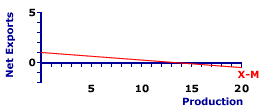
|
The negatively-sloped red line, labeled X-M in the exhibit to the right, indicates a typical net exports line. Line any straight line, this net exports line is characterized by two key parameters, intercept and slope. The intercept indicates autonomous net exports and the slope indicates induced net exports.Identifying numbers for these two parameters for this particular line indicates that the intercept is $1 trillion, meaning autonomous net exports is $1, and the slope is -0.075, meaning a $1 increase in domestic income or production induces a $0.075 decrease in net exports. A little more insight into these two parameters can be had by dividing net exports into exports and imports. A click of the [Exports] button presents the underlying exports line. This line is horizontal at a value of $1 trillion, indicating the exports are autonomous and equal to $1 trillion for every level of domestic income and production. A click of the [Imports] button adds the underlying imports line to this exhibit. The imports line is positively slope, indicating that imports are induced by domestic income and production. In this particular case, the imports line has a zero intercept, indicating no autonomous imports, but that need not be the case. Most notable is that the slope of the imports line is the marginal propensity to import, which is equal to 0.075. A $1 increase in domestic income or production induces a $0.075 increase in imports. However, because an increase in imports results in a corresponding reduction in net exports, the negative of the MPM is the slope of the net exports line. The net exports line, which can be displayed once again with a click of the [Net Exports] button is derived by vertically subtracting the imports line from the exports line.
Recommended Citation:NET EXPORTS LINE, AmosWEB Encyclonomic WEB*pedia, http://www.AmosWEB.com, AmosWEB LLC, 2000-2025. [Accessed: July 18, 2025].
Check Out These Related Terms... | | | | | | | | | | | |
Or For A Little Background... | | | | | | | |
And For Further Study... | | | | | | | | | | | | | | |
Search Again?
Back to the WEB*pedia
|

|

|
YELLOW CHIPPEROON
[What's This?]
Today, you are likely to spend a great deal of time searching the newspaper want ads trying to buy either a T-shirt commemorating the 2000 Olympics or a genuine fake plastic Tiffany lamp. Be on the lookout for telephone calls from former employers.
Your Complete Scope
This isn't me! What am I?
|

|
|
In 1914, Ford paid workers who were age 22 or older $5 per day -- double the average wage offered by other car factories.
|

|
|
"A winner is someone who recognizes his God-given talents, works his tail off to develop them into skills, and uses those skills to accomplish his goals. " -- Larry Bird, basketball player
|

|
HDI
Human Development Index
|

|
|
Tell us what you think about AmosWEB. Like what you see? Have suggestions for improvements? Let us know. Click the User Feedback link.
User Feedback
|

|