|
|
MATERIALS BALANCE: A hard and fast rule that the total amount of stuff removed from the natural environment will be eventually returned, probably as pollution. This is based on a fundamental law of physics that says material can be neither created nor destroyed, but only transformed. During any given period (such as a year) the quantity of materials returned to the environment is the difference between the quantity extracted and the quantity used by the economy.
Visit the GLOSS*arama
|
|


|

|
                           MARKET-CLEARING PRICE: The price that exists when a market is clear of shortage and surplus, or is in equilibrium. Market-clearing price is a common, non-technical term for equilibrium price. In a market graph, the market-clearing price is found at the intersection of the demand curve and the supply curve. Market-clearing price is the price that achieves a market balance. Because quantity demanded and quantity supplied are equal at the market-clearing price, there is no shortage nor surplus in the market, which means that neither buyers nor sellers are inclined to change the price, which is the primary condition for equilibrium.Moreover, because the market-clearing price also simultaneously equates the demand price and supply price, the market equilibrium generates an efficient allocation of resources (presuming competition and no market failures). Clearing the Market| Market-clearing Price | 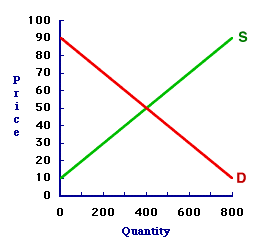 |
The market model displayed in the exhibit to the right can be used to identify the market-clearing price. This particular model represents the market for 8-track tapes, which are filled with the works of classic performers such as The Carpenters and Englebert Humperdink. The buyers and sellers happen to be folks attending the 88th Annual Trackmania 8-Track Tape Collectors Convention at the Shady Valley Exposition Center.The market-clearing price achieves a balance in the market, which is equality between quantity demanded and quantity supplied. In other words, it clears the market of any shortage or surplus. The only price that accomplishes this task is at the intersection of the demand curve and supply curve. This intersection point, and the price that achieves it, can be identified by clicking the [Market-Clearing Price] button in the exhibit. Doing so reveals a market-clearing price of 50 cents. At this price, the demand curve and supply curve intersect. The quantity demanded is 400 tapes and the quantity supplied is 400 tapes. The quantity demanded is equal to the quantity supplied. The buyers can buy all that they want, so there is no shortage. The sellers can sell all that they want, so there is no surplus. Neither buyers nor sellers are motivated to change the price. The forces of demand and supply are in balance. This is the ONLY price that achieves a balance between these two quantities. Best of all, because this is equilibrium, the market-clearing price of 50 cents will not change and the equilibrium quantity of 400 tapes will not change unless or until an external force intervenes.
Recommended Citation:MARKET-CLEARING PRICE, AmosWEB Encyclonomic WEB*pedia, http://www.AmosWEB.com, AmosWEB LLC, 2000-2025. [Accessed: July 18, 2025].
Check Out These Related Terms... | | | | | | | | | |
Or For A Little Background... | | | | | | | | | | | | |
And For Further Study... | | | | | | | | | | | | | | | | | |
Search Again?
Back to the WEB*pedia
|

|

|
RED AGGRESSERINE
[What's This?]
Today, you are likely to spend a great deal of time at a flea market wanting to buy either a weathervane with a cow on top or a box of multi-colored, plastic paper clips. Be on the lookout for telephone calls from long-lost relatives.
Your Complete Scope
This isn't me! What am I?
|

|
|
Helping spur the U.S. industrial revolution, Thomas Edison patented nearly 1300 inventions, 300 of which came out of his Menlo Park "invention factory" during a four-year period.
|

|
|
"A winner is someone who recognizes his God-given talents, works his tail off to develop them into skills, and uses those skills to accomplish his goals. " -- Larry Bird, basketball player
|

|
WACM
Weak Axiom of Cost Minimization
|

|
|
Tell us what you think about AmosWEB. Like what you see? Have suggestions for improvements? Let us know. Click the User Feedback link.
User Feedback
|

|