|
|
ECONOMIC COMMISSION FOR LATIN AMERICA: The Economic Commission for Latin America (ECLA) -the Spanish acronym is CEPAL- was established in 1948. ECLAC, which is headquartered in Santiago, Chile, is one of the five regional commissions of the United Nations. It was founded for the purposes of contributing to the economic development of Latin America, coordinating actions directed towards this end, and reinforcing economic relationships among the countries and with the other nations of the world. The promotion of the region's social development was later included among its primary objectives. The 33 countries of Latin America and the Caribbean are member States of ECLAC, together with several North American and European nations that have historical, economic and cultural ties with the region.
Visit the GLOSS*arama
|
|


|

|
                           CHANGE IN AGGREGATE DEMAND: A shift of the aggregate demand curve caused by a change in one of the aggregate demand determinants. A change in aggregate demand is caused by any factor affecting aggregate demand EXCEPT the price level. This is one of two changes related to aggregate demand. The other is a change in aggregate expenditures. A change in aggregate demand is comparable to a change in market demand. A change in aggregate demand is a shift in the aggregate demand curve. Because aggregate demand includes ALL price level-aggregate expenditure combinations, a change in aggregate demand is a change in ALL price level-aggregate expenditure combinations, meaning that each price level is matched up with a different aggregate expenditure after the change. This is illustrated as a shift of the aggregate demand curve. This change in aggregate demand is caused by a change in any of the aggregate demand determinants. In contrast, a change in aggregate expenditures is a change from one price level-aggregate expenditure combination on a given aggregate demand curve to another point on the same curve. This is illustrated as a movement along a given aggregate demand curve. | Change in Aggregate Demand | 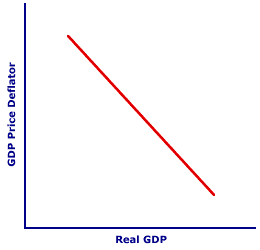
|
This exhibit to the right displays a standard aggregate demand curve. Two buttons are displayed beneath this graph. One, labeled [Determinant], demonstrates a determinant-driven change in aggregate demand. For comparison purposes, the other, labeled [Price Level], illustrates a price level-induced change in aggregate expenditures.A click of the [Determinant] button triggers a shift of the aggregate demand curve, in particular, a rightward shift representing an increase in aggregate demand. A click of the [Price Level] button triggers a movement along the aggregate demand curve. Why is this difference so important? The answer is as simple as cause and effect. The aggregate demand curve is used (together with the long-run and short-run aggregate supply curves) to explain and analyze macroeconomic events, especially business-cycle instability. The sequence of events follows a particular pattern. - First, a determinant (of either aggregate demand or aggregate supply) changes.
- Second, this determinant change causes the aggregate demand curve or one of the aggregate supply curves to shift. An aggregate demand determinant change causes a shift of the aggregate demand curve and an aggregate supply determinant change causes a shift in one of the aggregate supply curves.
- Third, the change in aggregate demand or aggregate supply causes an imbalance in the aggregate market (an economy-wide shortage or surplus). The aggregate market is in a temporary state of disequilibrium.
- Fourth, the economy-wide shortage or surplus causes the price level to change.
- Fifth, the change in the price level causes a change in aggregate expenditures and possibly real production.
- Sixth, the changes in aggregate expenditures and/or real production eliminate the shortage or surplus and restore equilibrium.
The key conclusion is that aggregate demand (and aggregate supply) determinants, which induce changes in aggregate demand (and aggregate supply), are the source of instability in the aggregate market. The change in the price level, which induces a change in aggregate expenditures (and real production) is the means of eliminating the instability and restoring equilibrium.
Recommended Citation:CHANGE IN AGGREGATE DEMAND, AmosWEB Encyclonomic WEB*pedia, http://www.AmosWEB.com, AmosWEB LLC, 2000-2025. [Accessed: July 18, 2025].
Check Out These Related Terms... | | | | | |
Or For A Little Background... | | | | | | | | | |
And For Further Study... | | | | | | | | | | |
Search Again?
Back to the WEB*pedia
|

|

|
BEIGE MUNDORTLE
[What's This?]
Today, you are likely to spend a great deal of time strolling around a discount warehouse buying club hoping to buy either a case for your designer sunglasses or arch supports for your shoes. Be on the lookout for crowded shopping malls.
Your Complete Scope
This isn't me! What am I?
|

|
|
Rosemary, long associated with remembrance, was worn as wreaths by students in ancient Greece during exams.
|

|
|
"A winner is someone who recognizes his God-given talents, works his tail off to develop them into skills, and uses those skills to accomplish his goals. " -- Larry Bird, basketball player
|

|
SEC
Securities and Exchange Commision
|

|
|
Tell us what you think about AmosWEB. Like what you see? Have suggestions for improvements? Let us know. Click the User Feedback link.
User Feedback
|

|