|
|
ADB: An abbreviation that stands for either the African Development Bank the Asian Development Bank. The African Development Bank is a regional multilateral development institution engaged in promoting the economic development and social progress of its member countries in Africa. The Bank, established in 1964, started functioning in 1966 with its Headquarters in Abidjan, Cote d' lvoire. The Bank borrows funds from the international money and capital markets. Its shareholders are the 53 countries in Africa as well as 24 countries in the Americas, Europe, and Asia. The Asian Development Bank is a multilateral development finance institution dedicated to reducing poverty in Asia and the Pacific that engages in mostly public sector lending for development purposes in its developing member countries. They pursue this goal by helping to improve the quality of people's lives providing loans and technical assistance for a broad range of development activities. ADB raises fund through bond issues on the world's capital markets but they also rely on members' contributions. The ADB was established in 1966 and has its headquarters in Manila, Philippines. As of September of 2003, the ADB had 58 member countries.
Visit the GLOSS*arama
|
|


|

|
                           MIXED ECONOMY: An economy, or economic system, that relies on both markets and governments to allocate resources. Every economy in the real world regardless of their common designation (such as capitalism, socialism, or communism) make use of both markets and governments and is technically a mixed economy. While, in theory, resource allocation could be undertaken exclusively through markets or exclusively through governments, in the real world all economies rely on a mix of both markets and governments for allocation decisions. Markets allocate resources through voluntary choices made by living, breathing people. Governments force allocation through involuntary taxes, laws, restrictions, and regulations. While everyone likely has their own personal favorite when it comes to using of markets or government to do the deed of allocation, both institutions play vital roles in a mixed economy.MarketsThe key term for markets is voluntary. Markets are the voluntary exchange of goods. No one forces a person to buy a hot fudge sundae for breakfast or work as a sales clerk at the jogging shoe boutique. People do a market exchange because they choose to.An economy that uses nothing but markets to allocate resources is called a pure market economy. This is a theoretical ideal that does not actually exist in the real world. But it provides an excellent benchmark for comparison with real world economies. Economists love benchmarks such as this, especially when practicing normative economics. GovernmentsThe key term for government allocation is involuntary. Governments set forth the laws and rules. If people do not follow the rules, then they are punished. Governments can punish those who do not follow the rules because... well... because that is what they do. Given a choice, people probably would rather NOT pay taxes or have their cars safety inspected. They follow government rules because they have to, because it is the law.An economy that uses nothing but government to allocate resources is called a pure command economy. This is also a theoretical extreme that does not actually exist in the real world. But like a pure market economy, it provides a benchmark for comparison with real world economies. A Real World Continuum| Mixed Economies | 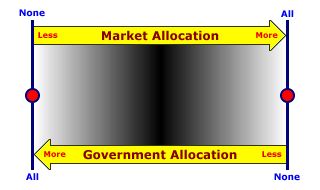 |
If pure market economies and pure command economies are theoretical ideals that do not actually exist in the real world, where does that leave real world economies? Somewhere in the middle. Real world economies form a continuum bounded by these two theoretical extremes.However, noting that real world economies are real and not theoretical ideals does not say much. While all real world economies are mixed, some mixed economies tend to use markets more than governments and others rely more on governments than markets. For example, capitalism is the popular term for a market-oriented economy that leans heavily to the market end. Socialism and communism are mixed economies that lean more (often a lot more) toward government control. Goals and PoliciesAn inherent dimension of a mixed economy is the pursuit of economic goals using assorted government policies. The five basic goals that are generally desired by society are: (1) full employment, (2) stability, (3) economic growth, (4) efficiency, and (5) equity. Governments take primary responsibility in the pursuit of these five goals with a wide variety of economic policies that assist, guide, control, and regulate voluntary market exchanges. Such policies take the form of: (1) laws passed by legislatures, (2) administrative actions taken by elected executives, (3) rules set forth by government agencies, and (4) decisions made through the courts.
Recommended Citation:MIXED ECONOMY, AmosWEB Encyclonomic WEB*pedia, http://www.AmosWEB.com, AmosWEB LLC, 2000-2026. [Accessed: November 15, 2026].
Check Out These Related Terms... | | | | | | | |
Or For A Little Background... | | | |
And For Further Study... | | | | | | | | | | |
Search Again?
Back to the WEB*pedia
|

|

|
YELLOW CHIPPEROON
[What's This?]
Today, you are likely to spend a great deal of time looking for the new strip mall out on the highway looking to buy either a genuine down-filled snow parka or throw pillows for your living room sofa. Be on the lookout for empty parking spaces that appear to be near the entrance to a store.
Your Complete Scope
This isn't me! What am I?
|

|
|
A lump of pure gold the size of a matchbox can be flattened into a sheet the size of a tennis court!
|

|
|
"Do something wonderful; people may imitate it. " -- Albert Schweitzer, theologian, physician
|

|
BLUE
Best Linear Unbiased Estimator
|

|
|
Tell us what you think about AmosWEB. Like what you see? Have suggestions for improvements? Let us know. Click the User Feedback link.
User Feedback
|

|