|
|
FACTOR DEMAND DETERMINANTS: The three most important determinants that shift the factor demand curve are: (1) product price, (2) factor productivity, and (3) prices of other factors. Like any determinant, these three cause the factor demand curve to shift to a new location. An increase in factor demand is a rightward shift of the factor demand curve and a decrease in factor demand is a leftward shift.
Visit the GLOSS*arama
|
|


|

|
                           CONSTANT-COST INDUSTRY: A perfectly competitive industry with a horizontal long-run industry supply curve that results because expansion of the industry causes no change in production cost or resource prices. A constant-cost industry occurs because the entry of new firms, prompted by an increase in demand, does not affect the long-run average cost curve of individual firms, which means the minimum efficient scale of production does not change. The primary reason for a constant-cost industry is that an increase in demand has no impact on production cost or the long-run average cost curve as new firms entering the industry obtain resources at constant prices. The entry of new firms into the retail industry, for example, can employ workers at the same wage as existing firms.First Demand The Constant-Cost
Zucchini Industry | 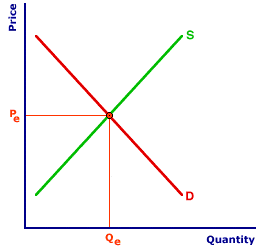
|
The perfectly competitive Shady Valley zucchini market can be used to illustrate a constant-cost industry. The original market equilibrium is presented in the exhibit to the right, with the supply curve S and the demand curve D. The market equilibrium price is Pe and the equilibrium quantity is Qe.The first step in identifying the long-run industry supply curve for a constant-cost industry is with an increase in demand. Click the [Demand Shift] button to illustrate the shift of the demand curve to D'. Note that with the increase in demand, the market price of zucchinis increases to Pe' and the equilibrium quantity rises to Qe'. The higher price and larger quantity are achieved as each existing firm in the industry responds to the demand shock. The higher price that buyers are willing to pay induces existing firms to increase their quantities supplied as they move along their individual marginal cost curves. The market, as such, moves along the original market supply curve from one equilibrium point to a higher equilibrium point. However, the higher price leads to above-normal economic profit for existing firms. And with freedom of entry and exit, economic profit attracts kumquat, cucumber, and carrot producers into this zucchini industry. An increase in the number of firms in the zucchini industry then causes the market supply curve to shift. How far this curve shifts and where it intersects the new demand curve, D', determines that the zucchini market is a constant-cost industry. The Supply ResponseEconomic profit induces non-zucchini firms to enter the zucchini industry. People like Dan the kumquat man begin producing zucchinis. As these new firms enter the zucchini industry, the market supply curve shifts rightward. The shift of the supply curve to S' can be seen with a click of the [Supply Shift] button. This new supply curve intersects the new demand curve, D', at the equilibrium price of Pe and the equilibrium quantity of Qo.The key for a constant-cost industry is how far the supply curve shifts. For a constant-cost industry the shift matches the shift of the demand curve. As new firms enter the industry, they pay the same resource prices and incur the same higher production cost as existing firms. Whatever the actual resource price, the end result is that the long-run average cost curve does not change. The minimum efficient scale for a given perfectly competitive firm is the same. This means that they can produce the extra quantity demanded by the zucchini buyers at the same per unit cost that had prevailed. The main point of interest is that the new equilibrium price is equal to the original. To display the resulting long-run supply curve for this constant-cost industry click the [Long-Run Supply Curve] button. The horizontal slope of the this long-run industry supply curve (LRS) indicates a constant-cost industry.
Recommended Citation:CONSTANT-COST INDUSTRY, AmosWEB Encyclonomic WEB*pedia, http://www.AmosWEB.com, AmosWEB LLC, 2000-2025. [Accessed: July 13, 2025].
Check Out These Related Terms... | | | |
Or For A Little Background... | | | | | | | | | | | |
And For Further Study... | | | |
Search Again?
Back to the WEB*pedia
|

|

|
RED AGGRESSERINE
[What's This?]
Today, you are likely to spend a great deal of time driving to a factory outlet trying to buy either rechargeable batteries or a rechargeable battery for your computer. Be on the lookout for neighborhood pets, especially belligerent parrots.
Your Complete Scope
This isn't me! What am I?
|

|
|
It's estimated that the U.S. economy has about $20 million of counterfeit currency in circulation, less than 0.001 perecent of the total legal currency.
|

|
|
"To sit back and let fate play its hand out, and never influence it, is not the way man was meant to operate." -- John Glenn, astronaut, U.S. senator
|

|
ES
Singapore Stock Exchange
|

|
|
Tell us what you think about AmosWEB. Like what you see? Have suggestions for improvements? Let us know. Click the User Feedback link.
User Feedback
|

|