|
|
RATIONAL BEHAVIOR: The notion that people make decisions based on the desire to obtain the greatest amount of satisfaction. Rational behavior essential means that people prefer more to less. The presumption of rational behavior underlies most economic analyses, especially those applied to consumer demand theory.
Visit the GLOSS*arama
|
|


|

|
                           GOVERNMENT PURCHASES DETERMINANTS: Ceteris paribus factors, other than aggregate income or production, that are held constant when the government purchases line is constructed and which cause the government purchases line to shift when they change. Some of the more important government purchases determinants are fiscal policy and politics. Government purchases determinants are ceteris paribus factors that determine the position of the government purchases line that plots the relation between government purchases and income. Changes in these determinants then cause shifts of the government purchases line. While the government purchases line is commonly assumed to be horizontal, reflecting autonomous government purchases, it realistically has a positive slope, indicating induced government purchases. Induced government purchases means that government purchases are based on the aggregate level of income or production in the economy. Government purchases are induced because governments, especially state and local governments use tax collections to finance their expenditures and purchases. A growing, expending economy invariably generates more tax revenue, which state and local governments are obliged to spend. A fall off in the economy, then restricts tax revenue and forces a reduction in government purchases. However, a number of other factors also affect government purchases independent of income. For example, a typical government entity like the Shady Valley city commission, might decide to increase its government purchases by building a new elementary school. This extra spending is NOT the result of an expanding economy. A windfall of tax revenues did flood into the city's bank account. Rather, this expenditure was undertaken for "other reasons" unrelated to income or production. The specific reason underlying Shady Valley's increase in spending was to replace an old elementary school that was destroyed by a flood of the adjacent Shady Valley River, after it was flattened by a massive tornado, which arose on the heals of a major earthquake centered directly under the school. In addition, a majority of the city commissioners, being proponents of improved public education, decided this was a prime opportunity to build a new, state-of-the art, technology-enhanced school. The commissioners also felt that this spending would stimulate a slumping Shady Valley construction industry and boost the overall level of activity in the local economy. What They Do| Determinants | 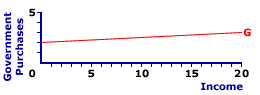
|
Government purchases determinants affect the government purchases line much like any determinants affect a corresponding curve--they cause the curve to shift.The exhibit to the right presents the government purchases line, labeled G. Government purchases determinants can trigger either an increase or a decrease in government purchases. - Increase in Government Purchases: An increase in government purchases is illustrated by an upward shift of the government purchases line. At each income and production level, the government sector undertakes greater government purchases. Click the [Increase] button to illustrate.
- Decrease in Government Purchases: A decrease in government purchases is illustrated by a downward shift of the government purchases line. At each income and production level, the government sector undertakes fewer government purchases. Click the [Decrease] button to illustrate.
These shifts of the government purchases line take center stage in Keynesian economics, especially when it comes to business-cycle correcting fiscal policy. A shift of the government purchases line causes a corresponding shift of aggregate expenditures line. If done correctly, this can be used to counter an opposite shift of the aggregate expenditures line caused by one of the other expenditures, especially investment. An upward shift can counter a business-cycle contracting inducing, unemployment causing decrease in investment. A downward shift can then counter a business-cycle expansion inducing, inflation causing, increase in investmentWhat They AreWhile government entities like Shady Valley city commission are bound to encounter a wide range of specific non-income factors affecting their own government spending (including floods and earthquakes), determinants affecting overall government purchases by the government sector tend to fall into a limited number of categories. Some of the more important determinants are:- Fiscal Policy: At the federal level, the desire to counter instability caused by other expenditures though fiscal policy is always a possibility. If aggregate expenditures decrease because of less spending from the household or business sectors, then the government sector is often inclined to spend more. Doing so increases government purchases and thus causes the government purchases line to shift upward. Alternatively, if aggregate expenditures have increased from extra consumption and investment to the point of triggering inflation, then the government is likely to decrease government purchases which thus causes the government purchases line to shift downward.
- Politics: Political considerations are always bubbling near the surface of government activity. Perhaps the political winds start to blow in the direction of reducing the federal deficit or limiting government funded social programs. Such a force could decrease government purchases and result in a downward shift of the government purchases line. Or perhaps a number of rather vocal and financially powerful interest groups convince political leaders to spend more on worthy activities, like the space program, national defense, or environmental quality. This shift in the political winds is bound to increase government purchases and lead to an upward shift of the aggregate expenditures line.
Recommended Citation:GOVERNMENT PURCHASES DETERMINANTS, AmosWEB Encyclonomic WEB*pedia, http://www.AmosWEB.com, AmosWEB LLC, 2000-2025. [Accessed: July 18, 2025].
Check Out These Related Terms... | | | | | | | | | | | |
Or For A Little Background... | | | | | | | | | | |
And For Further Study... | | | | | | | | | | | | | | | |
Search Again?
Back to the WEB*pedia
|

|

|
ORANGE REBELOON
[What's This?]
Today, you are likely to spend a great deal of time wandering around the downtown area trying to buy either shoe laces for your snow boots or a rim for your spare tire. Be on the lookout for the happiest person in the room.
Your Complete Scope
This isn't me! What am I?
|

|
|
Only 1% of the U.S. population paid income taxes when the income tax was established in 1914.
|

|
|
"A winner is someone who recognizes his God-given talents, works his tail off to develop them into skills, and uses those skills to accomplish his goals. " -- Larry Bird, basketball player
|

|
NLLS
Nonlinear Least Squares
|

|
|
Tell us what you think about AmosWEB. Like what you see? Have suggestions for improvements? Let us know. Click the User Feedback link.
User Feedback
|

|