|
|
ESTATE TAX: A tax on the value of a deceased person's estate, or all of the property and assets owned. This should be compared to an inheritance tax, which is a tax on that portion of the estate that an heir actually receives.
Visit the GLOSS*arama
|
|


|

|
                           MARGINAL FACTOR COST CURVE, MONOPSONY: A curve that graphically represents the relation between marginal factor cost incurred by a monopsony for hiring an input and the quantity of input employed. A profit-maximizing monopsony hires the quantity of input found at the intersection of the marginal factor cost curve and marginal revenue product curve. The marginal factor cost curve for a monopsony with market control is positively sloped and lies above the average factor cost curve. Monopsony is a market structure with a single buyer or in terms of factor markets, a single employer. This means that monopsony is a price maker with control over the buying side of the market. Market control means monopsony faces a positively-sloped supply curve. To buy a larger quantity, it must pay a higher price.The marginal factor cost curve reflects the degree of market control held by a firm. For a perfectly competitive firm with no market control, the marginal factor cost curve is a horizontal line. For firms with more market control, especially monopsony, the marginal factor cost curve is positively sloped and lies above the average factor cost curve. Marginal Factor Cost Curve,
Monopsony | 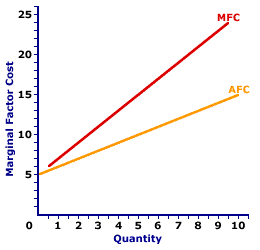 |
The marginal factor cost curve (MFC) for OmniKing Island Resort is displayed in the exhibit to the right. Key to this curve is that OmniKing is a monopsony buyer of workers and thus faces a positively-sloped supply curve. Larger quantities of input can be had only with higher prices.The vertical axis measures marginal factor cost and the horizontal axis measures the quantity of input (workers). Although quantity on this particular graph stops at 10 workers, it could go higher. This curve indicates that if OmniKing hires the first worker, then marginal factor cost is $6. Alternatively, if it hires the tenth worker, then marginal factor cost is $24. For reference, the factor supply curve (and average factor cost curve, AFC) is also presented in the exhibit. The key observation is that the positively-sloped marginal factor cost curve (MFC) lies above the supply curve (AFC) facing OmniKing for hiring labor. The positioning of the marginal factor cost curve above the average factor cost curve reflects the mathematical relation between an average and a marginal. Although this marginal factor cost curve is based on the employment activity of OmniKing Island Resort, a well-known monopsony firm, it works for any buyer with market control. Monopsonistic competition and oligopsony firms that also face positively-sloped supply curves generate comparable marginal factor cost curves.
Recommended Citation:MARGINAL FACTOR COST CURVE, MONOPSONY, AmosWEB Encyclonomic WEB*pedia, http://www.AmosWEB.com, AmosWEB LLC, 2000-2025. [Accessed: July 18, 2025].
Check Out These Related Terms... | | | | | | | | | |
Or For A Little Background... | | | | | | | | | | | |
And For Further Study... | | | | | | | | |
Search Again?
Back to the WEB*pedia
|

|

|
PINK FADFLY
[What's This?]
Today, you are likely to spend a great deal of time calling an endless list of 800 numbers wanting to buy either a weathervane with a cow on top or a box of multi-colored, plastic paper clips. Be on the lookout for high interest rates.
Your Complete Scope
This isn't me! What am I?
|

|
|
The Dow Jones family of stock market price indexes began with a simple average of 11 stock prices in 1884.
|

|
|
"A winner is someone who recognizes his God-given talents, works his tail off to develop them into skills, and uses those skills to accomplish his goals. " -- Larry Bird, basketball player
|

|
NABB
National Association of Business Brokers
|

|
|
Tell us what you think about AmosWEB. Like what you see? Have suggestions for improvements? Let us know. Click the User Feedback link.
User Feedback
|

|